Measured product lead custody receipt.
github.com/Zer0pa/Indus-ValleyRESEARCH-READY
LIVE
v0.1.0
4,500 Years Undeciphered, Now Searchable
Gnosis Indus-Valley · PyPI gnosis-indus v0.1.0 · 412 signs · 70 clusters · github.com/Zer0pa/Indus-Valley
Live experiment. Not a release. Ambition headlined. Claims bounded.
The Indus script has gone unread for a century. Thousands of marks on seals, tablets, and tools — catalogued, contested, photographed — and no one knows what they say.
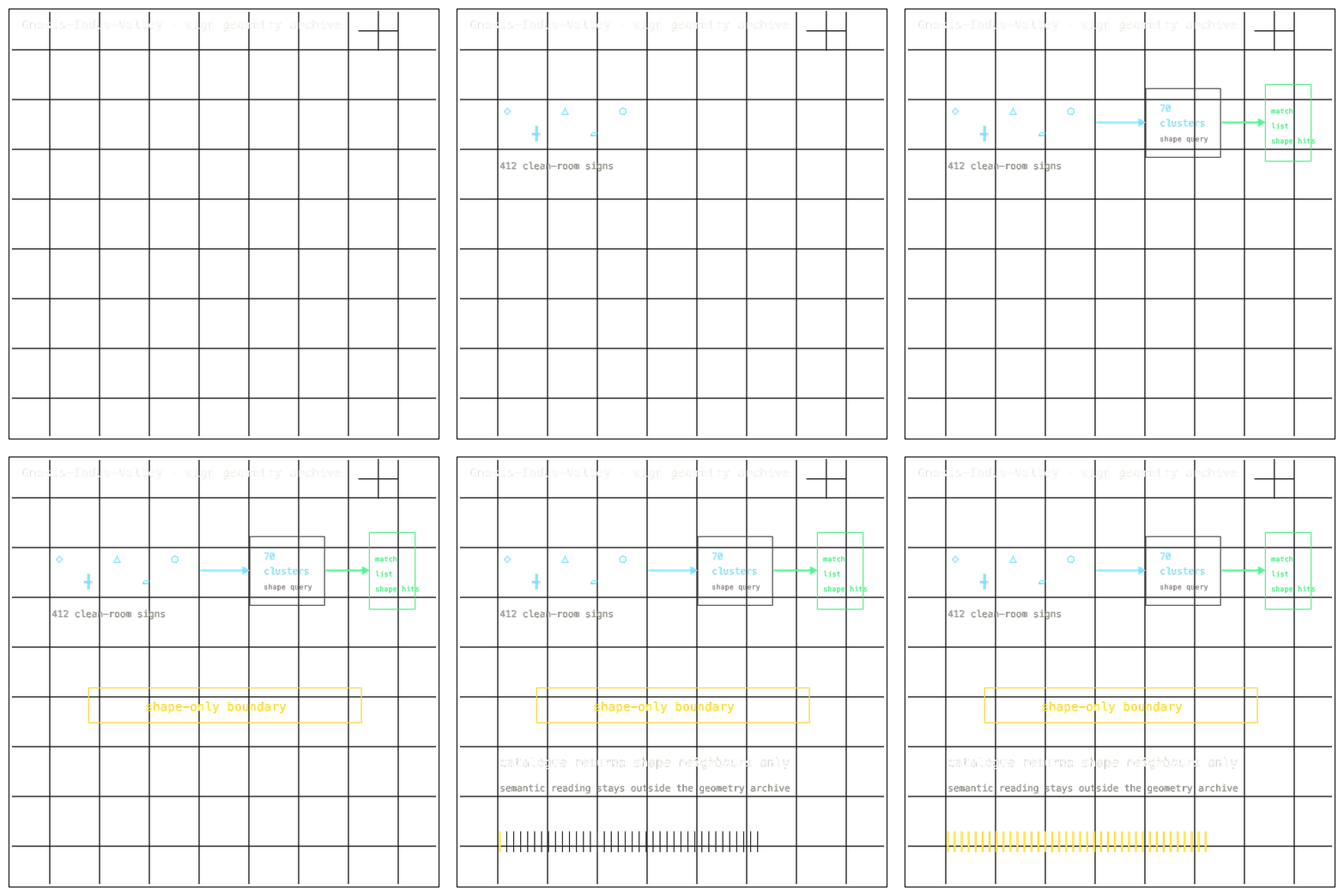
What was missing was not more scholarship. It was a way to search the corpus by the shape of the marks, without claiming what they mean. gnosis-indus ships a clean-room 412-sign / 70-cluster catalogue and answers shape queries in 0.0451 ms. No glyph is read.
01 · THE GAPA CENTURY WITHOUT SHAPE SEARCH
The Indus script has gone undecoded for a century; its marks were never searchable by shape.
02 · MARKETSADJACENT FORECASTS
source: heritage and research-infrastructure forecasts. Best-fit users: epigraphy labs, museum archives, and digital-humanities groups. No traction or TAM claim.
03 · VALUE
$8.1B
Heritage digitization is funded. Tools that index this script by shape, without claiming to read it, remain almost absent.
04 · INSIGHT
The mark has a shape; that shape can be searched.
05.1 · CURRENT TECHCATALOGUED, NOT SEARCHABLE BY FORM
Indus scholarship lives in sign catalogues, visual classifications, and concordances. They let scholars compare marks one at a time, but no tool let them query the whole corpus by the shape of a single sign.
05.2 · OUR TECHSEARCH BY SHAPE
gnosis-indus is a clean-room runtime: no neural model, no learned embedding, no substrate hypothesis. It bundles a conditional 412-sign / 70-cluster catalogue and answers shape queries in 0.0451 ms. The full 179-inscription corpus stays fetch-external under data policy. No glyph is read; only the shape is found.
05.3 · BENCHMARKSSEARCH TARGET + NMI
Query latency0.0451 ms
target100 ms
NMI0.5793vs ICIT
sigma5.65
Result: demo shape search 0.0451 ms vs 100 ms target · NMI 0.5793 vs ICIT Sets.
06 · MEASUREMENTSEARCH TARGET · NMI · STRUCTURE
Shape search clears latency; decipherment is deliberately unmeasured.
06.1 · COMPARATIVE PERFORMANCE · DEMO FIXTURE
Demo shape search at 0.0451 ms against a 100 ms target — roughly 2,217× under. Catalogue NMI 0.5793 vs ICIT Sets at sigma 5.65. Phase 5 substrate question unresolved; no reading claimed.
07 · KEY METRICSMEASURED RESULTS
07.1 · MAX QUERY LATENCY
0.0451ms
Demo shape search · vs 100 ms target
07.2 · CATALOGUE NMI
0.5793
vs ICIT Sets · sigma 5.65
07.3 · PHASE 5 VERDICT
STRUCT
Linguistic structure confirmed · substrate unresolved
07.4 · PYPI RELEASE
0.1.0
PyPI gnosis-indus · public, reproducible
07.5 · CATALOGUE SCOPE
412signs
70 clusters · 179 inscriptions; full corpus fetched separately
08 · DETERMINISMSEARCH THAT REPLAYS
Same query. Same fixture. Same matches. replay clones agree.
08.1 · WHAT REPLAYS EXACTLYDEMO SEARCH SURFACE
The runtime is clean-room — no neural model, no learned embeddings, no substrate guess. The same shape query against the bundled fixture returns the same matches across replay clones, every time, anchored to the same source records.
The catalogue is conditional on Phase 4 stability, and the Phase 5 source-structure question is unresolved. Determinism covers shape search, not interpretation. No glyph is read, and the runtime is built so it cannot quietly start to.
08.2 · HONEST BLOCKER
Honest Blocker ·
No reading claimed. The Phase 5 source-structure question is unresolved: we do not know what language, if any, the script encodes. Sign images stay policy-limited under DATA_POLICY.md. The bundled fixture is small; the full 412 / 70 / 179 catalogue is fetched separately.
09
Shape search only no reading claims.
09.1 · THE AMBITION
The ambition is computational restraint. gnosis-indus gives Indus scholarship a search surface, a cluster map, and a comparison primitive — and stops there. The refusal to read is not a hedge. It is the product. A catalogue researchers and museums can trust because it never overreaches into translation.
09.2 · WHAT WORKS NOW
Shape search runs in 0.0451 ms; NMI confirms structure without reading.
09.3 · WHAT'S STILL OPEN
Substrate question unresolved; image policy limited. catalogue is conditional, and full corpus stays fetch-external for now.
09.4 · SCHOLARSHIP · NEAR-TERM (12–24 MO)
Indus scholars can search by shape
A paleographer who notices a familiar mark on a newly photographed seal can find every visually related sign across the corpus in milliseconds. The conversation moves from "have I seen this before" to "here are the seventeen places it appears."
09.5 · DEBATE · NEAR-TERM (12–24 MO)
Decipherment debate gets cleaner footing
Comparisons among signs and clusters can stay anchored to structure, not to translation guesses. Researchers arguing competing theories share the same shape-grounded reference instead of talking past each other about disputed readings.
09.6 · MUSEUMS · MID-TERM (24–48 MO)
Museum catalogues gain a structural index
Curators can attach sign-family and cluster labels to seal records alongside images. Visitors and remote researchers query holdings by mark shape, and discovery surfaces stop depending on a translation no museum is willing to assert.
09.7 · METHOD · MID-TERM (24–48 MO)
Shape search becomes shared infrastructure
The same primitive — search by form, refuse to read — generalises to other undeciphered scripts: Linear A, Proto-Elamite, Rongorongo. Shape-first analysis becomes a shared method, and labs stop rebuilding the same catalogue plumbing from scratch.
09.8 · DISCIPLINE · PARADIGM (48 MO+)
Honest non-claim becomes a scientific asset
In contested heritage, a maintained refusal to overclaim outlasts every dramatic weak claim. The Indus catalogue stands as the durable object: a corpus researchers, curators, and the public can trust precisely because it never said what the signs mean.