Measured product lead custody receipt.
github.com/Zer0pa/ZPE-MentalRESEARCH-READY
LIVE
LINUX WHEEL ONLY
Exploring A Codec For Mental Forms
Four-form endogenous-visual codec · ZPE-Mental · PyPI zpe-mental v0.1.0 · github.com/Zer0pa/ZPE-Mental
Live experiment. Not a release. Ambition headlined. Claims bounded.
Perceptual science has described tunnel, spiral, lattice, and cobweb for nearly a century — the four Klüver form constants people see in the mind's eye — but no one had ever pinned them to an exact, replayable shape.
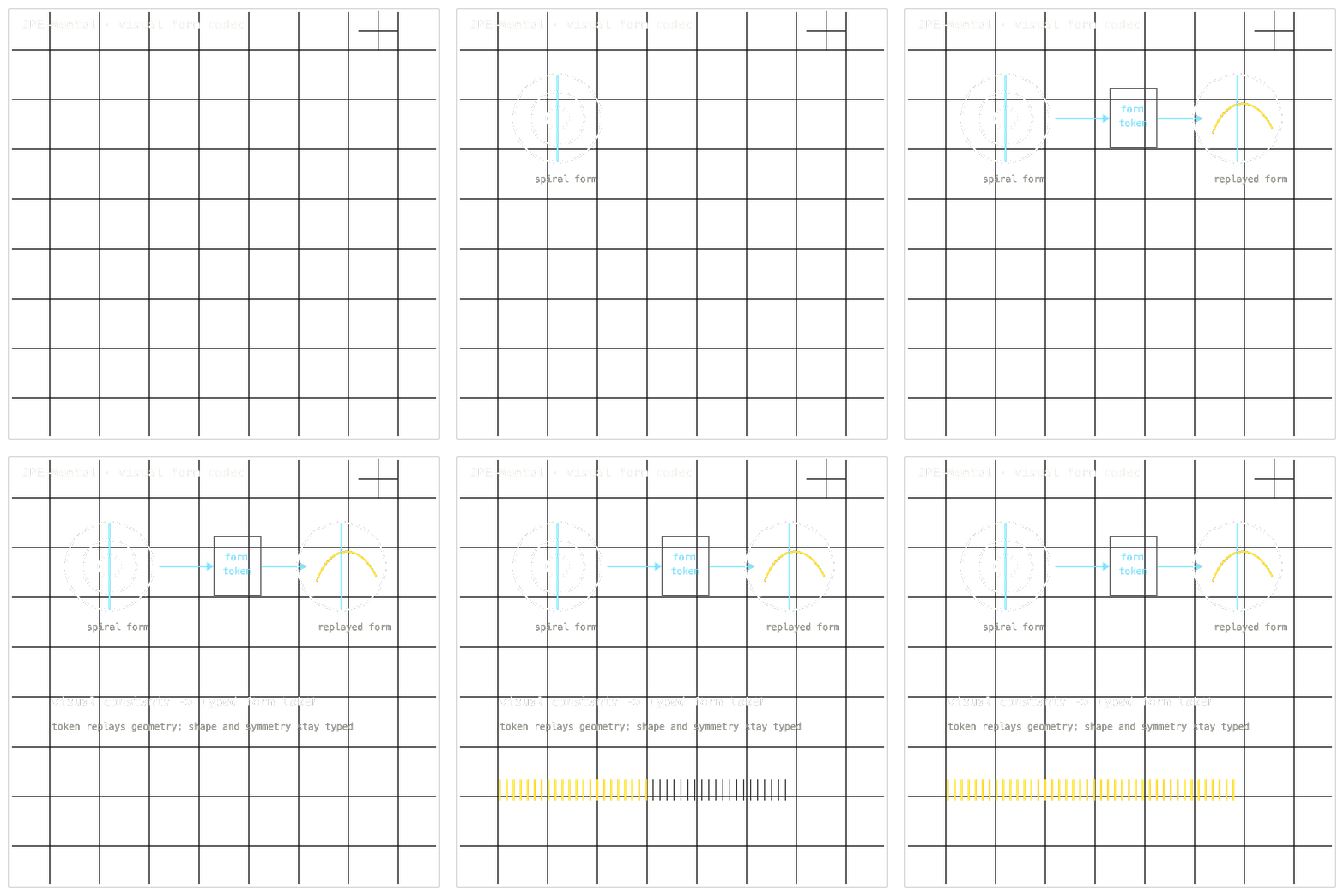
ZPE-Mental writes each form into a 20-bit packet and brings it back byte-identical across a Rust-native fast path and a Python reference. Non-visual prompts collapse to a bounded fallback. No cognition, clinical, diagnostic, or autobiographical claim is made — just the four forms, replayed exactly.
01 · THE GAPDESCRIBED, NOT CAPTURED
These forms have been described in words for a century. none were captured exactly.
02 · MARKETSADJACENT FORECASTS
Adjacent research-infrastructure estimates only; ZPE-Mental is a small replay tool for four named visual forms, not a market claim.
03 · VALUE
$0.75B/yr
NIH BRAIN Initiative annual funding; ZPE-Mental serves perceptual research as a four-form fixture tool.
04 · INSIGHT
Fix the form. Tunnel, spiral, lattice, cobweb — the same shape every time.
05.1 · CURRENT TECHDESCRIBED, NOT PINNED
Klüver named these four forms in 1928, and perceptual science has studied them ever since. Yet every reference depends on prose, sketches, or rendered images that drift between researchers, devices, and decades. The form itself was never standardised.
05.2 · OUR TECHPIN THE FORM
ZPE-Mental writes each of the four forms into a 20-bit packet with profile and symmetry metadata, then returns the exact same bytes whether it runs in Rust or in Python. Non-visual prompts collapse to a documented fallback rather than producing a plausible-looking form. Two profiles — COMPASS_8 and D6_12 — are represented; coverage stays narrow on purpose.
05.3 · BENCHMARKSFOUR-FORM CORPUS
FORM_EXACT1.00fidelity
Rust ↔ Python0.00bytes Δ
Pytest3/3PASS
PyPI0.1.0stale
Scope: four named forms only · 20-bit packet · cobweb 1.00
06 · MEASUREMENTCORPUS PARITY CHECK
Each form measured against a known reference, replayed identically every run.
06.1 · COMPARATIVE PERFORMANCEFOUR-FORM FORM_EXACT
FORM_EXACT fidelity · ZPE-Mental 0.1.0 · validation/corpora/endogenous_forms.json · Rust ↔ Python byte equality (0-byte delta); four named forms only, no external clinical comparator.
07 · KEY METRICSFOUR-FORM AGGREGATE
07.1 · FORM FIDELITY
1.00
FORM_EXACT · four named forms
07.2 · RUST ↔ PYTHON
0.00B
Byte delta · fast path = reference
07.3 · PYTEST SUITE
3 / 3
PASS · v0.1.0 commit e3412beb
07.4 · PYPI STATE
0.1.0
CONNECTED · STALE PENDING 0.1.1
07.5 · WIRE FORMAT
20-bit
Four fixtures · two profiles represented
08 · DETERMINISMBYTE-EXACT FOUR-FORM REPLAY
Tunnel, spiral, lattice, cobweb —
byte-exact across Rust and Python.
08.1 · WHAT DETERMINISTIC MEANSFOUR-FORM SURFACE
Each of the four named forms — tunnel, spiral, lattice, cobweb — encodes into a 20-bit wire format and decodes to byte-identical bytes across the Rust-native fast path and the Python reference. FORM_EXACT = 1.00 is the falsification check. Non-visual prompts do not silently produce a plausible form: they collapse to a documented fallback (NON_VISUAL_SEMANTIC_RETENTION 0.00, NON_VISUAL_ALIAS 1.00) so that any non-visual input is recoverable as such. The COMPASS_8 and D6_12 profiles are represented, not exhaustive.
08.2 · THE FIDELITY GAP
Honest Blocker ·
No cognition decoding, autobiographical recovery, language understanding, theorem proving, legal or moral reasoning, clinical diagnosis, therapy, medical-device, regulatory, mental-health-assessment, or prosthetics use. The release corpus is exactly four endogenous visual-form examples — tunnel, spiral, lattice, cobweb. No all-forms/all-profiles coverage; PyPI remains 0.1.0 stale pending 0.1.1 metadata release.
09
FOUR FORMS, ONE citable shape.
09.1 · THE AMBITION
ZPE-Mental gives perceptual science its first deterministic packet for the Klüver form constants. Tunnel, spiral, lattice, and cobweb become stable fixtures a psychophysics lab can specify, share, and replay without arguing over rendering or wording — a small, exact contribution to a question that has resisted exact treatment since 1928.
09.2 · WHAT WORKS NOWEXTERNAL
Working today: four named forms at FORM_EXACT 1.00; Rust and Python decode identically; three of three tests pass.
09.3 · WHAT'S STILL OPENEXTERNAL
Still open: broader form coverage, full profile range, and the 0.1.1 metadata release that retires the stale PyPI 0.1.0.
09.4 · REPLICATION · NEAR-TERM (12–24 MO)
Perceptual experiments get a shared vocabulary
A psychophysics group that ran a tunnel-stimulus study in 2024 can hand a 20-bit packet to a 2026 replication team and know both labs are testing the exact same shape — not a screenshot, not a verbal description.
09.5 · STIMULUS LIBRARIES · NEAR-TERM (12–24 MO)
Stimulus libraries get a fidelity floor
A perception lab maintaining a long-running stimulus library no longer drifts as workstations, GPUs, and rendering toolchains turn over. Tunnel, spiral, lattice, and cobweb resolve to identical bytes across devices and years, so longitudinal studies stop fighting their own equipment.
09.6 · PSYCHEDELIC RESEARCH · MID-TERM (24–48 MO)
Clinical trials use a controlled stimulus vocabulary
Researchers studying psychedelic-induced visual experience cite Klüver form constants constantly but compare them with prose. A four-form packet vocabulary lets multi-site trials, IRB submissions, and published results refer to the same stimulus identity without ambiguity.
09.7 · BOUNDARY DISCIPLINE · MID-TERM (24–48 MO)
Replication studies acquire an audit instrument
Because non-visual prompts collapse to a documented fallback rather than producing a plausible form, a reviewer can probe a published endogenous-visual claim against a bounded reference. Replication science gains a small, exact tool for separating claimed visual content from prompt artefact.
09.8 · CITABLE FORMS · PARADIGM (48 MO+)
Perceptual forms become citable objects
A spiral or lattice referenced in a paper carries an identifier the next reader can retrieve and verify, the way DOIs anchor text. Perceptual research gains the citation infrastructure that text and data already enjoy — a foundation a century of Klüver scholarship has lacked.