
Measured product lead custody receipt.
github.com/Zer0pa/DM3R&D RESTART
DRAFT
GATE OPEN
Computation You Can Hold To Account
Rebuilding DM3 from receipts, not inheriting old claims — DM3 · github.com/Zer0pa/DM3
Live experiment. Not a release. Ambition headlined. Claims bounded.
Most computation asks you to trust the answer. DM3 asks whether the answer can be traced back to the exact run that made it.
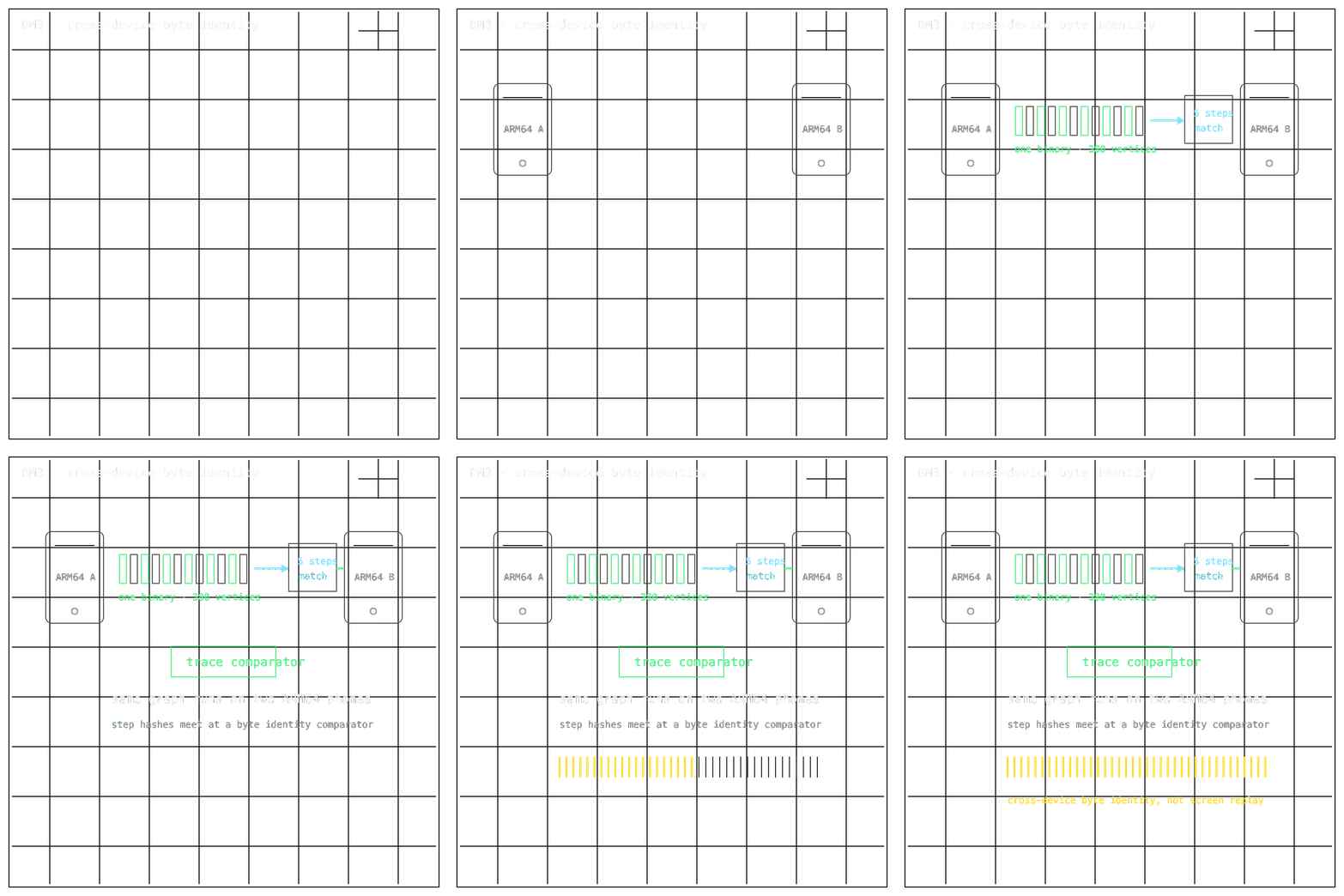
We start small on purpose: one tau experiment, one phone under custody, one recovered M1 report, and a handful of matching steps. Small is the point. A narrow object can be checked, rebuilt, and broken.
The work now is to make every part of that object answerable: source, build, runtime trace, inputs, outputs, and hashes. DM3 is the attempt to turn a calculation into something you can hold to account.
01 · THE GAPNO RECEIPT
Old claims are not evidence; the rebuild must make the object testable.
02 · MARKETSADJACENT FORECASTS
Adjacent markets are context only. The lab claim is not market size; it is whether a fixed computation can earn source-bound, receipt-backed sameness.
03 · VALUE
$173.5B
Potential context only. No market claim matters unless the reconstruction gate closes with receipts.
04 · INSIGHT
Same object. Same receipts; then hypotheses.
05.1 · CURRENT TECHCLAIMS OUTRUN RECEIPTS
Old research notes can mix mechanism, ambition, and proof into one story. The restart splits them apart: custody first, source/build second, invariant hypotheses third. Anything else is objective substitution.
05.2 · OUR TECHREBUILDABLE RECEIPTS
The current mechanism pins a small tau computation and asks whether the exact binary/input packet can be replayed, traced, and eventually rebuilt. RM10 custody and the recovered M1 packet are useful; they are not yet a broad determinism proof.
05.3 · BENCHMARKSINTERNAL DRAFT 2026-06-15
Steps5/5matches
ScopeTAUonly
EvidenceRM10+ M1 packet
GateOPENR8/source
Scope: one tau task packet, steps {20, 30, 40, 45, 50}; old geometry-first claims are hypotheses until rebuilt and source-bound.
06 · MEASUREMENTSHA-256 RECEIPT CHAIN
When a claim survives, the receipt names the object.
06.1 · COMPARATIVE PERFORMANCE · SHA RECEIPT ON STATIC TIER-2
Checked 2026-06-15. RM10 custody and recovered M1 tau receipts are the floor. R8 trace and source/build provenance are the next gate; no old manifold result is inherited as proof.
07 · KEY METRICSRECONSTRUCTION PACK
07.1 · TAU MATCH
5/5
Recovered scoped tau steps · not broad platform proof
07.2 · R8 TRACE
OPEN
argv/openat/write still needed · object binding gate
07.3 · CALLABLE TASKS
12
Reported modes in the binary surface · not all verified
07.4 · STATE DIMENSION
72,960D
State footprint under review · must survive source replay
07.5 · SOURCE
OPEN
Build or escrow required · no README upgrade
08 · DETERMINISMHASH-SCOPED REBUILD
Not a USP yet; a gate decides.
08.1 · WHAT DETERMINISTIC MEANSRECEIPT AGREEMENT ONLY
Current determinism means the scoped tau receipts agree at named steps and can be inspected against hashes. It does not mean the old geometry-first manuscript is accepted, and it does not mean a source-rebuilt primitive exists.
The reconstruction path is stricter: bind the exact object, replay it, rebuild or escrow it, then test whether contraction, energy descent, boundary recovery, and topology stress survive independent fixtures.
08.2 · THE HONEST BLOCKER
Honest Blocker ·
R8 and source/build provenance remain open. Old manifold language is research fuel, not authority. DM3 is a reconstruction workstream until the exact tau object is trace-bound and source-bound.
09
WHEN A REBUILD becomes a primitive.
09.1 · THE AMBITION
The ambition is not to preserve an old claim packet. It is to reconstruct a geometry-first computation until the exact object, source path, and falsifiers are visible. If the invariants survive, DM3 may become a real primitive; today it is a disciplined lab restart.
09.2 · WHAT WORKS NOW
What holds today: RM10 custody, recovered M1 tau receipts, and verifier scaffolding; the gate is still open.
09.3 · WHAT'S STILL OPEN
Still open: R8 argv/openat/write trace, source/build provenance, baselines, and no claim upgrade.
09.4 · REBUILD · NEAR-TERM (0–3 MO)
The old packet becomes executable
The next win is not a stronger page claim. It is a source-bound tau run where the binary, inputs, trace, outputs, and verifier all point at the same object.
09.5 · MOBILE QA · CONDITIONAL
Device drift gets a receipt
If the gate closes, a mobile team can ask where a fixed computation diverged. Until then, this remains a target use case, not a product promise.
09.6 · GEOMETRIC PRIMITIVE · CONDITIONAL
Contraction must predict behavior
A geometry-first primitive only becomes interesting if contraction or energy descent predicts a measurable advantage over ordinary fixed-point or graph baselines.
09.7 · BOUNDARY RECEIPTS · CONDITIONAL
Boundary state must beat baselines
The old boundary/interior story only matters if it gives a narrower receipt or reconstruction advantage than conventional hashing, logging, or error-correcting codes.
09.8 · LAB STANDARD · CONDITIONAL
A claim becomes a rerunnable event
The long-term prize is an independent lab packet: source, runner, inputs, traces, outputs, falsifiers, and failure bands, all narrow enough to rerun without trusting the story.
10 · UPCOMING RESEARCHGPD HYPOTHESIS QUEUE
10.1 · R8/SOURCE · OBJECT GATE
Bind the object before theory
Capture argv/openat/write trace and source/build or escrow for the exact tau runner. Kill every manifold hypothesis until binary, inputs, outputs, and receipt path bind.
10.2 · CONTRACTION · INVARIANT
Map the fixed-point envelope
Rebuild the minimal update path and measure convergence under seeds, couplings, and fixtures. Kill if uniqueness depends on one frozen graph or hidden constants.
10.3 · ENERGY DESCENT · LYAPUNOV
A scalar must fall first
Define energy before running and log every step. Continue only if descent survives controls and perturbations. Kill if the metric is fitted after outputs.
10.4 · BOUNDARY/BULK · CAPACITY
Boundary recovery needs limits
Test interior reconstruction, masked-boundary thresholds, and ordinary ECC baselines. Kill if hashes, logs, or standard coding explain the same fidelity.
10.5 · TOPOLOGY/FORCING · STRESS
Change the graph, then fail cleanly
Vary topology, precision, cyclic forcing, and adversarial perturbations. Continue only if failures map to invariants; kill if behavior is one fixture.