
Measured product lead custody receipt.
github.com/Zer0pa/Glyph-EngineRESEARCH-READY
LIVE
OWNED ARM UNTESTED
Mapping Symbols Older Than Alphabets
Shape-only descriptor research for ancient script · Gnosis-Glyph-Engine · gnosis-glyph-engine v0.1.0a1 · github.com/Zer0pa/Glyph-Engine
Live experiment. Not a release. Ambition headlined. Claims bounded.
Ancient inscriptions carry geometry that no one has counted at the level of a single mark.
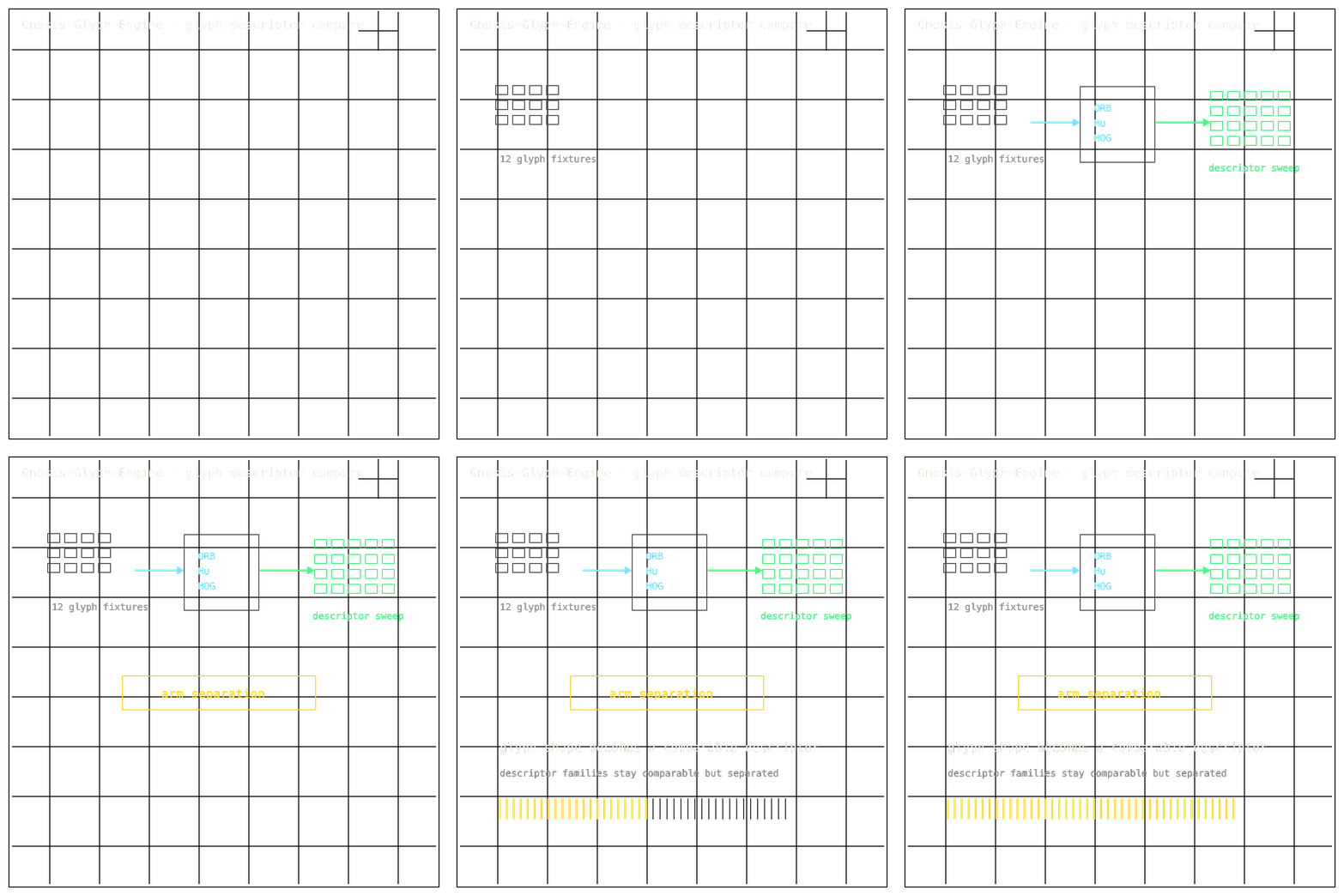
Glyph-Engine runs three off-the-shelf shape algorithms — ORB, Hu regionprops, and HOG — across a 12-glyph fixture, ten seeds deep, and reports how steady each one is. HOG is the steadiest at sigma 1.15. Re-running with the same seed gives the same numbers, bit for bit. The page does not claim to read or decipher the marks, and the in-house descriptor stays UNTESTED until two missing Indus source files are recovered.
01 · THE GAPREADING VS MEASURING
Paleography names ancient marks; shape can be measured without reading it.
02 · MARKETSADJACENT FORECASTS
Adjacent markets run on shape recognition; ancient-script geometry is the narrow, mostly unpriced corner inside them.
03 · VALUE
$8.1B
Heritage digitization '30 — the funded market where ancient-mark geometry becomes usable scholarly evidence.
04 · INSIGHT
Ancient marks have a shape. now it can be counted.
05.1 · CURRENT TECHDESCRIBED, NOT MEASURED
Epigraphers and paleographers describe ancient marks by sign name, period, or catalogue entry. No common tool reports the geometry of the stroke itself, so visual arguments rest on prose and plates, not on numbers.
05.2 · OUR TECHGEOMETRY MEASUREMENT FIRST
Glyph-Engine puts numbers on shape and reports how steady each number is. Three off-the-shelf algorithms — ORB, Hu regionprops, and HOG — run ten-seed sweeps over a 12-glyph synthetic fixture, with HOG at sigma 1.15 the steadiest. The same fixture and seeds are shared with the sibling Morph-Bench project. The in-house descriptor is not yet running, and nothing on this page claims to read a mark.
05.3 · BENCHMARKSBORROWED-ARM RESULTS
ORB σ4.1410-seed mean
Hu σ2.9510-seed mean
HOG σ1.15most stable
Tests17/17with sibling
Status: The three off-the-shelf algorithms have numbers; the in-house descriptor is UNTESTED until two missing Indus source files are recovered.
06 · MEASUREMENTBORROWED-ARM SIGMA
Three off-the-shelf shape algorithms read the 12-glyph fixture. the in-house descriptor is not running yet.
06.1 · COMPARATIVE PERFORMANCE · 10-SEED SIGMA
10-seed σ mean across borrowed ORB, Hu regionprops, and HOG over the 12-glyph synthetic fixture; lower σ means a more stable shape number. The owned descriptor has no number yet.
07 · KEY METRICSMEASURED RESULTS
07.1 · ORB ROBUSTNESS Σ
4.14
10-seed mean · borrowed OpenCV ORB
07.2 · HU REGIONPROPS Σ
2.95
10-seed mean · borrowed scikit-image regionprops
07.3 · HOG ROBUSTNESS Σ
1.15
10-seed mean · steadiest borrowed arm
07.4 · PYTEST SURFACE
17/17
17 pass with sibling · 16 pass plus 1 skip without it
07.5 · OWNED DESCRIPTOR Σ
null
Owned descriptor pending · D-06 is the unblock
08 · DETERMINISMPER-ARM REPLAY
Seed-42 replay covers borrowed arms; owned descriptor remains unproved.
08.1 · WHAT DETERMINISM MEANSBORROWED BASELINES ONLY
At seed 42, each borrowed ORB, Hu regionprops, and HOG arm replays identically: replay_all_identical == true. The reference-freeze SHA-256 is byte-stable across the declared 12-glyph fixture. The same fixture produces the same numbers, every run.
That does not prove owned descriptors, real glyphs, or arbitrary scripts. The unit of bit-exactness is per-arm, per-seed, borrowed baselines only. Shape measurement without determinism is anecdote; determinism is the thin floor under everything else here.
08.2 · HONEST BLOCKER
Honest Blocker ·
package_boundary_earned is UNTESTED. PyPI 0.1.0a1 is a public alpha with metadata pending. D-06 must retrieve scripts/indus/stroke_native_encoding.py and phase3_common.py before owned arms run. Claims stop at borrowed-baseline receipts: no release, no owned encoder, no production engine, no script understanding.
09
Marks with measured shape not claimed as reading.
09.1 · THIS REPO'S AMBITION
Glyph-Engine wants ancient-mark geometry to become an evidence layer that heritage researchers, paleographers, and decipherment specialists can share. The ambition is a shape vocabulary that travels between archives and journals without smuggling in a reading, so the conversation about what the marks mean can rest on what they actually look like.
09.2 · WHAT WORKS NOW
Borrowed shape arms produce stable numbers; the 12-glyph fixture replays today.
09.3 · WHAT'S STILL OPEN
Owned descriptor and real-glyph corpus stay untested; D-06 must retrieve missing Indus files.
09.4 · ARCHIVES · NEAR-TERM (12–24 MO)
Heritage archives sort marks by shape
A heritage archive curator can group thousands of unread marks by geometric similarity instead of cataloguer notes. The same descriptor numbers travel between corpora, so sorting decisions are reviewable by anyone, not stuck in one institution's house style.
09.5 · SCHOLARSHIP · NEAR-TERM (12–24 MO)
Paleographers gain a measurement vocabulary
A paleographer publishing a stroke-form argument can attach a sigma figure to the visual claim. Reviewers can re-run the descriptors against their own corpus and disagree on numbers instead of impressions, which moves epigraphic debate onto firmer ground.
09.6 · DECIPHERMENT DISCIPLINE · MID-TERM (24–48 MO)
Shape and meaning stay separated
Script-decipherment specialists working on contested scripts get a reusable shape layer that refuses to encode a reading. That keeps speculative translations from quietly leaking into descriptor metadata, which is how earlier decipherment programmes contaminated the evidence they were trying to weigh.
09.7 · TOOLING · MID-TERM (24–48 MO)
Digital humanities tools share one floor
A digital-humanities lab adopting Glyph-Engine baselines as a common floor can compare its custom descriptors against three well-understood arms before publishing a kernel. Comparison becomes the first step, not the last, so weak descriptors are caught before they reach a manuscript.
09.8 · METHOD · PARADIGM (48 MO+)
Geometry travels across heritage domains
A descriptor kernel that earns its independent boundary can move beyond ancient script into seals, pottery marks, textile motifs, and rock art. The portable object is the measurement method itself, which is what changes how heritage research builds reusable evidence.