
Measured product lead custody receipt.
github.com/Zer0pa/ZPE-RoboticsRESEARCH-READY
LIVE
GPD QUEUE OPEN
Robots That Remember What They Practiced
Task-state homeostasis · multi-signal coherence · recoverability · viability codec · ZPE-Robotics local research review
Live experiment. Not a release. Ambition headlined. Claims bounded.
Robots already record almost everything they do. The problem is that a recording is not the same as a memory.
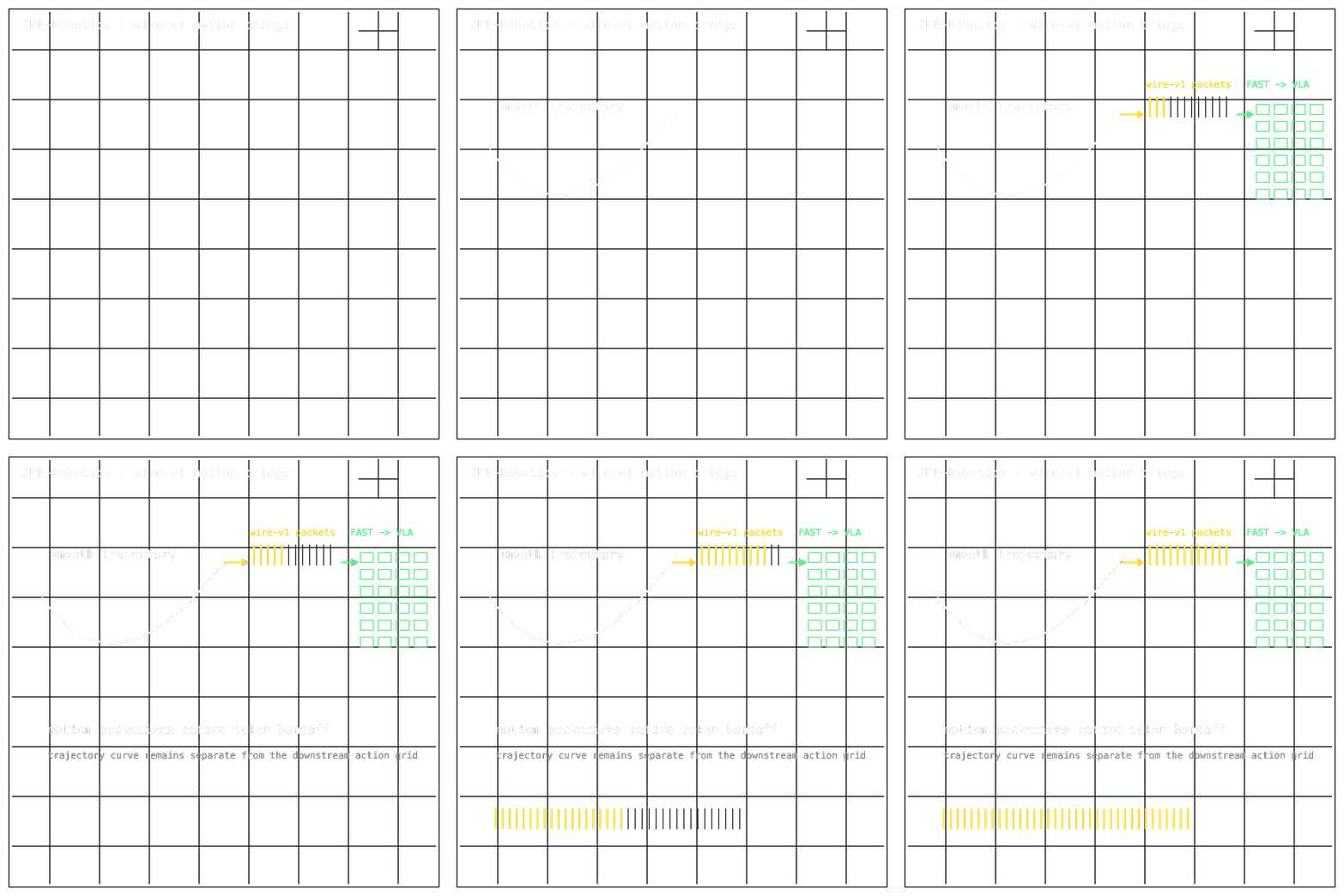
ZPE-Robotics asks whether a taught movement can leave a usable shape behind: something a robot can search, compare, and recover without replaying every joint trace from the beginning.
The work starts where the receipts are strongest: smooth motion, declared archives, and clear failures when the movement changes too sharply. That boundary matters. It tells us what the system knows, and what it still cannot pretend to know.
01 · THE GAPLOGGED, NOT REGULATED
Robots log what happened, but not the target state they were trying to restore.
02 · MARKETSADJACENT FORECASTS
Robot software — ’31 — $67.9B · Digital twin — ’30 — $155.8B · Warehouse robotics — ’30 — $17.3B · Industrial robotics — ’30 — $16.5B · AMR — ’30 — $8.7B · source: original staging scaffold
The live wedge is not broad robot memory. It is policy CI, contact-rich failure triage, and edge viability telemetry if the next metrics beat incumbents.
03 · VALUE
5
ranked GPD branches · no product pass claimed
04 · INSIGHT
Nature regulates toward target form, not replayed coordinates.
05.1 · CURRENT TECHOBSERVES AND EXPLAINS
Observability stacks, VLM explainers, and runtime failure detectors can replay channels or label failures. They usually do not encode the object relation being regulated, the recoverable basin, or which subsystem stopped serving the episode-level goal.
05.2 · ZPE POSTURERECEIPT BEFORE PRODUCT
ZPE-Robotics should now be read as a falsification harness plus legacy archive evidence. The next code surface must turn object relations, contact, force, phase, and multi-signal telemetry into receipts that beat FIPER, ActProbe, SAFE, PCA, DCT, and FDI-style baselines.
05.3 · EVIDENCE FLOORRESEARCH RECEIPTS
Smooth archive187.13× legacy receipt
Movement schemaNOsovereign pass
CurationNOproduct pass
H1 incidentFAILvs fixed-window
Scope: this local page is research-ready only. No README upgrade, no shipped claim, no primitive pass.
06 · MEASUREMENTNO PASS THEATRE
Current receipts say what not to sell as much as what to test next.
06.1 · GATE LEDGER · RESEARCH POSTURE
The latest local history includes retrieval-only and audit-only signals, failed functional curation, and a failed command-actual incident receipt. Phase 13 H1 hit 0.2500 and 0.3125 first-divergence coverage, below fixed-middle baselines at 0.5000 and 0.4375. That is a pivot trigger, not a product story.
07 · KEY METRICSHONEST FLOOR
07.1 · PRODUCT PASS
0GATES
public claim upgrades remain frozen
07.2 · ARCHIVE FLOOR
187.13×
legacy smooth-motion receipt only
07.3 · H1 RECEIPT
0.25-0.31
coverage lost to fixed-window baseline
07.4 · README
FROZEN
agent must not upgrade claims
07.5 · QUEUE
5
upcoming research branches selected
08 · EVIDENCE BOUNDARYARCHIVE VS PRIMITIVE
Archive evidence is not a robot-learning primitive; the next gate must prove new signal.
08.1 · WHAT EXISTSNEGATIVE RECEIPTS COUNT
There is a real audit trail: smooth archive measurements, retrieval slices, curation trials, functional curation trials, and the command-actual incident gate. Most of that trail is negative. It is useful because it removes fake wedges.
The remaining live direction is narrower and more serious: contact-rich manipulation where object relation, force, phase, recoverability, and signal coherence can be measured against strong baselines on public data.
08.2 · HONEST BLOCKER
Honest Blocker ·
No sovereign product pass. The lane needs at least one branch where target-state, coherence, or viability-code receipts beat FIPER, ActProbe, SAFE, PCA/DCT, fixed windows, or classical fault isolation on held-out contact-rich robot data.
09RESEARCH QUESTION
Can task state become receipt instead of another robot log?
09.1 · THE AMBITION
The aim is not to sell a dashboard or rescue a motion archive. The aim is a narrow primitive underneath robot policy work: a compact receipt that says what task state was being regulated, when the episode left viability, and what kind of intervention would matter.
09.2 · WHAT WORKS NOW
The receipt discipline works: failed branches stay failed, and the page does not upgrade them.
09.3 · WHAT'S STILL OPEN
Still open: task-state advantage, subsystem localization, matched-rate codec value, and recoverability utility.
09.4 · DATA · NEXT
Contact-rich data or stop
REASSEMBLE, AIRoA MoMa, RoboMIND, DROID, and LeRobot-format paths matter because they expose object relations, force, phase, or failure labels. Smooth movement alone is no longer enough.
09.5 · NATURE · TRIGGER
Biology points to target regulation
Michael Levin's target morphology, cognitive glue, TAME, and bioelectric-code work are investigation triggers. They do not prove ZPE. They force concrete invariants, experiments, and falsifiers.
09.6 · WEDGE · CONDITIONAL
Policy CI and triage only if metrics win
The marketable surface is a robot policy regression gate, incident root-cause API, or edge viability codec. None are public claims until the branch beats incumbent baselines.
09.7 · BASELINES · PRESSURE
Incumbents are the test not background noise
FIPER, ActProbe, SAFE, AgentChord, PCA/DCT compression, Foxglove, Rerun, MCAP, VAE anomaly, and FDI methods define the minimum bar.
09.8 · KILL LOGIC · ALWAYS
No biology language can rescue a loss
If a branch reduces to replay, demo selection, generic retrieval, or prettier anomaly detection, it is killed or demoted. Cross-domain pattern is a reason to test, not a result.
10 · UPCOMING RESEARCHGPD HYPOTHESIS QUEUE
10.1 · TSHR · PRIMARY
Task-state homeostasis receipt
Test whether object-relation deviation predicts failure earlier than FIPER, ActProbe, fixed windows, and end-effector error. Kill if it collapses into ordinary Euclidean error or loses on held-out contact-rich tasks.
10.2 · MSCF · PRIMARY
Multi-signal coherence field
Test whether force, joints, gripper, vision, and phase coupling breaks before failure and localizes the defecting subsystem. Kill if PCA, VAE anomaly, or single-channel FDI performs as well.
10.3 · LBVC · CODEC
Low-bandwidth viability state codec
Train an information-bottleneck latent for task viability at matched bit rates. Kill if PCA, DCT, FFT, or raw downsampling matches failure AUC and onset lead time.
10.4 · TAME · TRIAGE
Intervention-level classifier
Map failure receipts to the lowest useful intervention: retry, nudge, recalibrate, controller retune, policy retrain, hardware repair, or task redesign. Kill if a simple failure taxonomy routes as well.
10.5 · BASIN · RECOVERY
Morphospace viability basin
Map task states as viable, recoverable, or unrecoverable regions. Kill if OOD detection, fixed-window failure timing, or standard planners find the same boundary with equal actionability.