
Measured product lead custody receipt.
github.com/Zer0pa/ZPE-GeoRESEARCH-READY
LIVE
G1 BLOCKED
Journeys Remembered As Paths, Not Points.
Archive-native path-shape search research · ZPE-Geo · G1 synthetic pass · real AIS labels blocked
Live experiment. Not a release. Ambition headlined. Claims bounded.
Location data tells you where something was. It often misses what the journey was doing.
ZPE-Geo is testing whether a path can be remembered by its shape: harbor approach, channel transit, stop, turn, drift, return. Those are not just points on a map. They are behavior.
The first surface is synthetic because it can be labelled cleanly. Real AIS labels and stronger baselines still have to decide whether the idea survives outside the lab.
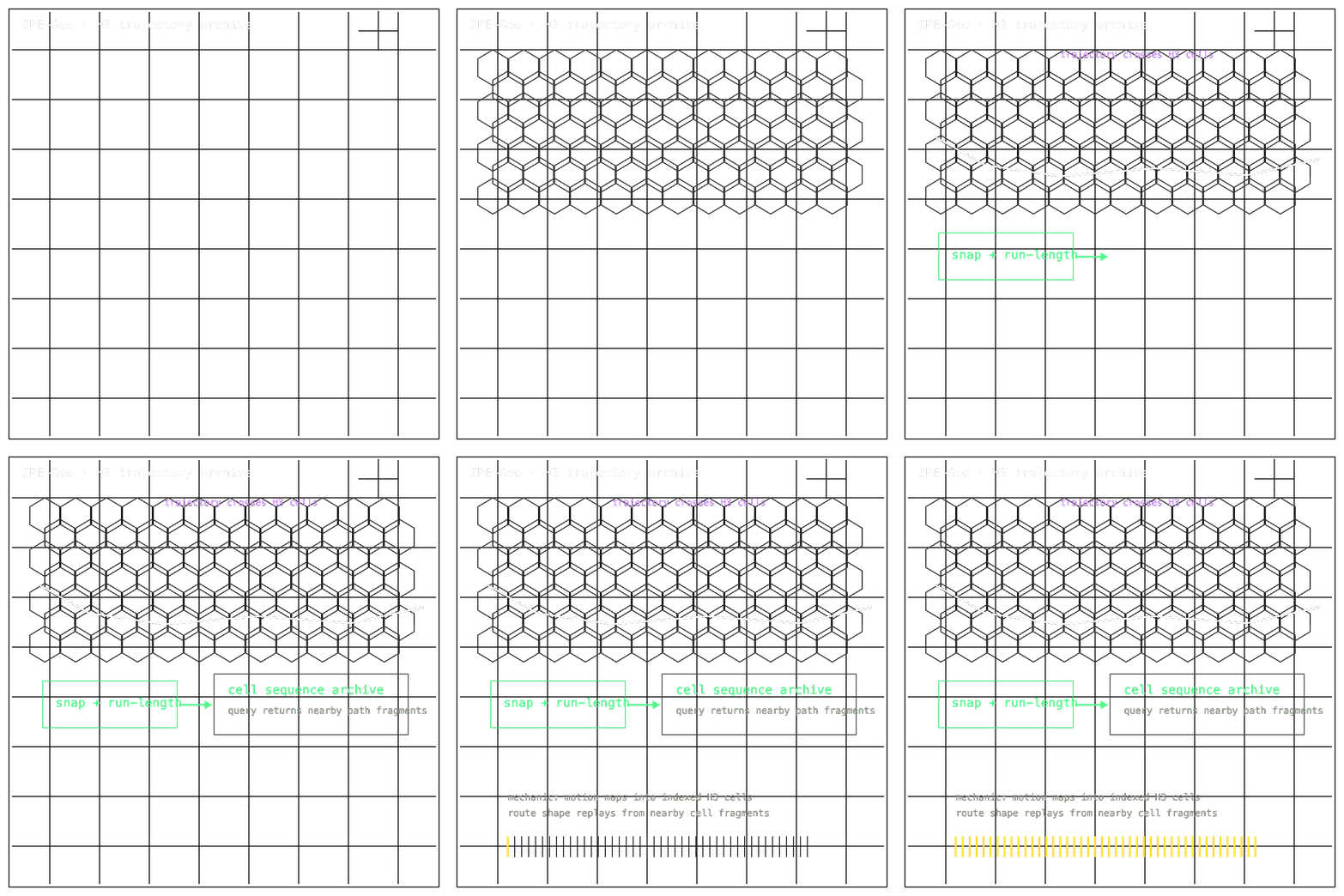
01 · THE GAPARCHIVE/SEARCH GAP
GPS captures where you were. it cannot tell you what the journey looked like.
02 · MARKETSADJACENT FORECASTS
Mordor Intelligence, MRFR, ResearchAndMarkets · external trajectory-adjacent forecasts, not a ZPE-Geo revenue claim.
03 · VALUE
$36.2B
Fleet telematics by 2030; ZPE-Geo addresses the archive-and-search slice, not navigation or fleet intelligence.
04 · INSIGHT
A route is not its waypoints — it is its arc.
05.1 · CURRENT TECHCOORDINATES, NOT PATHS
GPS logs, GeoJSON files, parquet tables: a journey today becomes a list of timestamped coordinates. The shape between them — its curve, its arc — is inferred later, or lost.
05.2 · OUR TECHPACKET-FIRST SEARCH
ZPE-Geo now tests whether packet-derived route features can answer behavior queries after originals are dropped from the search path. Synthetic AIS passes; real labels, H3/geofence retrieval, queryable compression, and qdelta pressure remain the gate.
05.3 · RUN SIGNALSG1 SYNTHETIC
AIS P@101.0synthetic only
AIS MRR1.0synthetic only
VerdictBLOCKEDlabels missing
BaselineQDELTAalso passes synthetic
Status: archive-native search exists, synthetic AIS retrieval passes, and real AIS labels decide the next public claim.
06 · MEASUREMENTG1 · SYNTHETIC · BLOCKERS
Every metric stays tied to the archive-native search gate.
06.1 · G1 GATE READOUTSYNTHETIC PASS · REAL LABEL BLOCKER
This review copy removes old compression/performance headline language. The current authority packet is a research gate: lossy archive-native route-shape search must survive real labelled AIS and fair baselines before public claim promotion.
07 · KEY METRICSG1 RECEIPTS · CLAIM FREEZE
07.1 · G1 PIPELINE
BUILT
Archive-native search path · raw originals out of retrieval
07.2 · SYNTH AIS
1.0
Macro P@10 / MRR · locked synthetic route classes
07.3 · BASELINES
FAIR
Neutral seeds · qdelta/H3/Douglas-Peucker pressure
07.4 · BLOCKER
LABELS
Real AIS route classes · needed for USP promotion
07.5 · PUBLIC CLAIM
FROZEN
No README upgrade · until real AIS gate passes
08 · DETERMINISMG1 PIPELINE REPLAY
Same trajectory bytes,
same query results on fixtures.
08.1 · WHAT DETERMINISTIC MEANSREPEATABLE ON DECLARED SURFACES
The G1 pipeline now locks a query contract, encodes trajectories, drops originals from the search path, and emits route-shape evidence packets. The synthetic AIS suite replays cleanly; real labelled AIS is still the authority blocker.
The deterministic claim is narrow: same declared inputs, same packet artifacts, same synthetic retrieval result. It does not prove commercial archive search, legal custody, or standard compatibility until real labelled AIS and independent replay receipts exist.
08.2 · THE LABEL GAP
Honest Blocker ·
Synthetic route labels are not enough. The next gate needs real AIS route-behavior labels, neutral seeds, fair baselines, query-class contracts, and receipts showing the archive can be searched after lossy encoding. No compliance, custody, or standard claim is made here.
09
EVERY JOURNEY BECOMES a queryable path.
09.1 · THE AMBITION
The aim is not a better mapping system. It is the archive beneath one. When a trajectory keeps its shape, a route can be stored compact and retrieved by the path it traces — searched by behavior, not by timestamp. Reaching it depends on real labelled AIS, H3/geofence pressure, queryable-compression pressure, and branch tests from the biocomputation research queue.
09.2 · WHAT WORKS NOW
Working today: archive-native search machinery and synthetic AIS retrieval receipts.
09.3 · WHAT'S STILL OPEN
Still open: real AIS labels, baseline resistance, blind replay, and proof that lossy search preserves behavior.
09.4 · AIS ARCHIVES · NEAR-TERM (12–24 MO)
Vessel histories searched by route shape
This remains the near-term wedge only if real labelled AIS confirms that compact path packets keep behavior-critical route shape under fair baselines.
09.5 · FLEET AUDIT · NEAR-TERM (12–24 MO)
A compliance question becomes a search
For an archive owner, the near-term value may be QA: detecting when lossy storage destroyed behavior-critical route information before an analyst trusts the compressed archive.
09.6 · TRAJECTORY IDENTITY · MID-TERM (24–48 MO)
A route gets a durable name
If collision and tolerance tests pass, a route can gain a stable behavior identity. Until then, route identity remains a branch hypothesis, not a provenance claim.
09.7 · AV ROUTE LIBRARIES · MID-TERM (24–48 MO)
Self-driving fleets keep every test mile
AV and robotics scenario search remain second-wave branches. They should test maneuver grammar, signatures, and field-relative packets only after the AIS/archive-QA signal survives harder baselines.
09.8 · MOVEMENT CUSTODY · PARADIGM (48 MO+)
Movement history acquires provenance
If the open checks close, route-shape evidence packets may support audit and review. Until then, movement custody is a research direction, not a legal or compliance surface.
10 · UPCOMING RESEARCHGPD HYPOTHESIS QUEUE · BIOCOMPUTATION / CODEC BRANCHES
10.1 · PATH SIGNATURE PACKET
Route behavior as a compact path integral
Test rough-path signatures against qdelta and H3 under point dropout. It matters because the packet may preserve order, curvature, and speed-shape without raw coordinates. Kill it if qdelta or H3 match P@10 at equal bytes.
10.2 · BEHAVIOR PRESERVATION TOKEN
Archive QA before route behavior is lost
Store a compact signature-drift token and sweep compression levels. It matters because archive owners need to know when valid lossy storage has destroyed a route task. Kill it if token drift does not predict retrieval failure.
10.3 · FIELD-RELATIVE ATTRACTOR
Harbor routes as constraint-field basins
Encode route progress, clearance, curvature, and transition order relative to channels, berths, and anchorages. It matters because Levin-style target morphology maps best to constrained fields. Kill it if geofence or channel-ID sequences already solve the class.
10.4 · WEAK AIS ROUTE LABELS
Remove the blocker without inventing truth
Build reproducible weak labels for approaches, channel transits, stop-go anchorages, and berth turnarounds. It matters because G1 is blocked on real labels. Kill it if labels are not reproducible or require post-hoc interpretation.
10.5 · TASK-SUFFICIENT FRONTIER
Find the byte point where behavior breaks
Plot bytes against route-query quality for signatures, qdelta, H3, RDP, and ZPE packets. It matters because compression only counts if the task survives. Kill it if no elbow appears or a conventional encoding owns the frontier.