
Measured product lead custody receipt.
github.com/Zer0pa/ZPE-NeuroRESEARCH-READY
LIVE
SOVEREIGN OPEN
Keeping Biology Attached To Evidence
Bioelectric morphogenesis receipt search · ZPE-Neuro · old spike-event path narrowed to pipeline QA · github.com/Zer0pa/ZPE-Neuro
Live experiment. Not a release. Ambition headlined. Claims bounded.
Biology does not happen one spike at a time. A signal means something because of the tissue, timing, shape, and experiment around it.
ZPE-Neuro is being rebuilt around that context. The question is whether a biological claim can carry a receipt that keeps the conditions of the claim attached to the data.
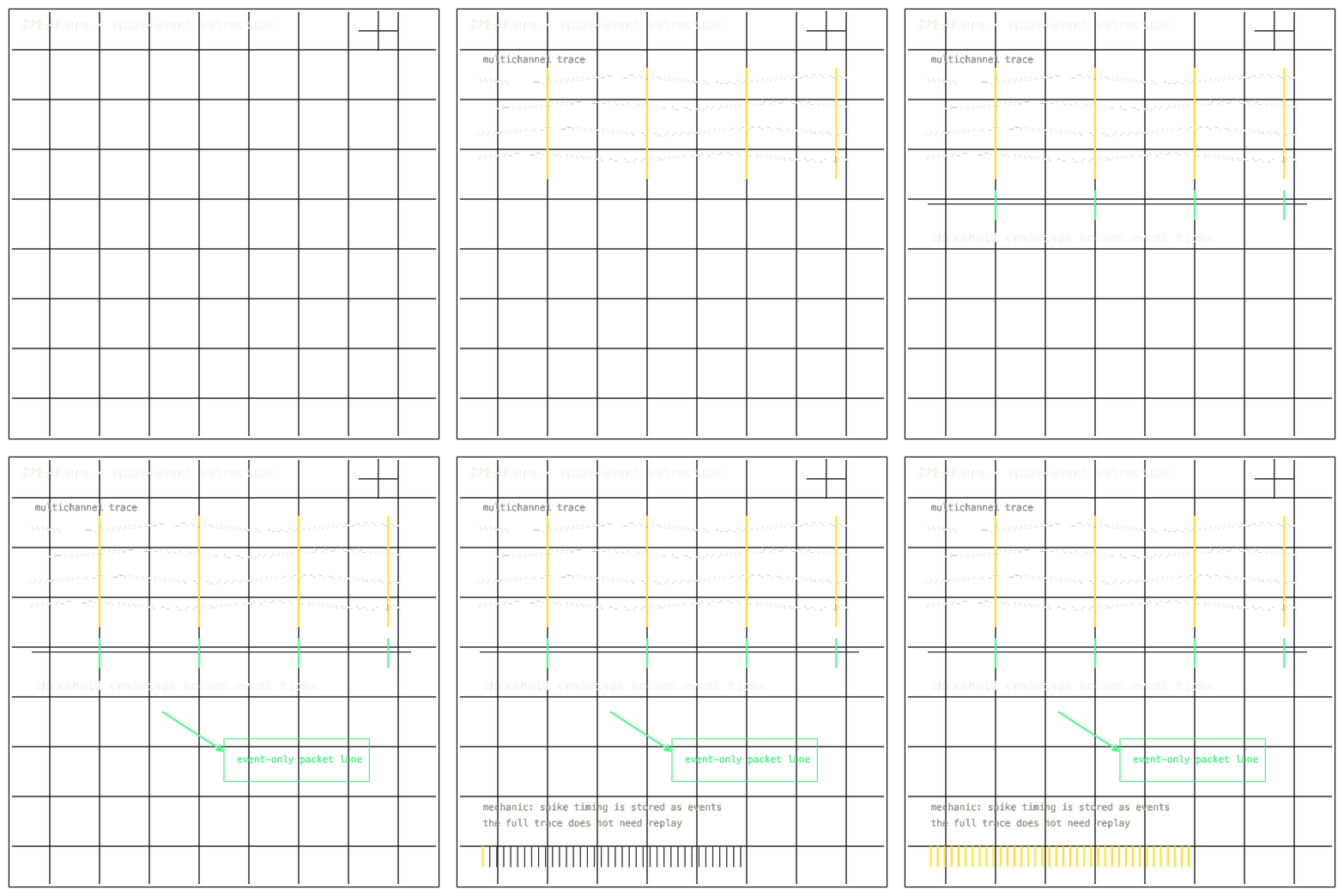
The old spike-event tools still matter, but as plumbing. The public claim is narrower and more useful: make the evidence easier to trace before pretending it explains the organism.
01 · THE GAPBIOLOGICAL CONTEXT
Biology claims travel farther than their source context. the receipt layer is still missing.
02 · WEDGEBUYER PAIN SIGNALS
The near wedge is not a shipped neuro codec. It is claim-grade context preservation for morphogenesis, organoid, and bioelectric workflows, if held-out baselines leave a real ZPE-only row.
03 · VALUE
5
GPD branches queued · no sovereign or market claim yet
04 · INSIGHT
The object may not be the spike. it may be the biological context a claim must keep.
05.1 · CURRENT TECHMETADATA FIRST
OMERO, OME-NGFF, REMBI, RO-Crate, DataLad, SpikeInterface, and Elephant already cover important pieces of metadata, provenance, and signal analysis. They are the baseline, not a strawman.
05.2 · OUR TECHRECEIPTS, TESTED
ZPE-Neuro now has deterministic receipt and falsification harnesses. The current evidence says those harnesses are useful for pipeline QA, but no buyer-relevant non-subsumed primitive has survived baseline attack.
05.3 · BENCHMARKSPHASE 5–9 FLOOR
Sovereign0pass
Phase 090ZPE-only
Branches5queued
StatusQAnarrow
Scope: Phases 5–9 failed closed or narrowed. New bioelectric branches are queued, not proven.
06 · MEASUREMENTNON-SUBSUMPTION
The next gate is not prettier provenance. it is a held-out baseline delta.
06.1 · COMPARATIVE EVIDENCE · RECEIPT NON-SUBSUMPTION
The old route detects seeded damage, but direct baselines and configured policies explain the useful rows. Section 10 names the next branches that must beat that floor.
07 · KEY METRICSRESEARCH-READY FLOOR
07.1 · SOVEREIGN
0
Primitive passes · claim upgrades forbidden
07.2 · PHASE 09
QA
Temporal receipts narrowed · pipeline use only
07.3 · ZPE-ONLY
0
Rows after policy attack · not a wedge
07.4 · TESTS
11
Focused regressions reported · does not promote claims
07.5 · QUEUE
5
Upcoming GPD branches · section 10
08 · DISCIPLINENO GATE, NO UPGRADE
Useful receipts are not enough. the sovereign gate still decides.
08.1 · WHAT THE CHECKS MEASURESCOPED CLAIM
The current checks measure whether a receipt pipeline can bind source, table, event, temporal relation, and visible artifact claims tightly enough to catch seeded damage. They do not prove a new neuro codec, compression primitive, clinical workflow, or standards replacement.
08.2 · THE FIDELITY GAP
Honest Blocker ·
Non-subsumption MISS: Phase 5, 7, 8, and 9 did not earn a sovereign pass. Direct and configured baselines overlap the useful rows. Public Vmem data is thin. Bioelectric morphogenesis branches are research candidates only.
09
ONE FAIL-CLOSED LANE opens five better tests.
09.1 · THIS REPO'S AMBITION
The ambition is not to revive a weak spike-compression story. It is to discover whether biology offers a software primitive around distributed target state, context preservation, or source-to-claim identity that survives held-out baseline attack.
09.2 · WHAT WORKS NOWEXTERNAL
Working today: receipt generation, seeded falsification, GPD phase tracking, and baseline attack discipline.
09.3 · WHAT'S STILL OPENEXTERNAL
Still open: prove a ZPE-only, buyer-relevant row against public held-out data and direct incumbents.
09.4 · CLAIM RECEIPTS · NEAR-TERM
Figures point back to the right biology
The first useful wedge is a receipt that catches wrong source, wrong stage, wrong perturbation, or context-dropped biological claims that normal metadata does not already catch.
09.5 · MODEL BRIDGE · NEAR-TERM
BETSE and Planform become auditable
A model-to-data receipt binds simulator state, perturbation, predicted morphology, empirical morphology, and hashable run custody into one falsifiable object.
09.6 · TARGET ERROR · MID-TERM
Shape becomes distance from repair
A target-morphology receipt only matters if its error vector predicts recovery, failure, or intervention outcome better than static shape metrics.
09.7 · INTERVENTION QA · MID-TERM
Perturbations become comparable transformations
A bioelectric intervention receipt has to normalise ion-channel, gap-junction, field, and timing changes well enough to improve retrieval or triage over protocol text.
09.8 · STANDARDS INTERFACE · PARADIGM
Receipts sit beside standards, not above them
If the branch works, it should compose with OMERO, OME-NGFF, REMBI, RO-Crate, and DataLad rather than pretending those layers do not exist.
10 · UPCOMING RESEARCHGPD HYPOTHESIS QUEUE
10.1 · MODEL-TO-DATA RECEIPT
BETSE / BEN / Planform bridge
Test whether executable morphogenesis states rank held-out morphology outcomes above intervention-only and morphology-only baselines. Kill it if static baselines match.
10.2 · BIOSIGNAL CLAIM RECEIPT
Source-to-claim context audit
Bind figure, segmentation, claim text, source asset, stage, sample, and perturbation. Kill it if OMERO, RO-Crate, DataLad, or a configured policy catches the same rows.
10.3 · TARGET MORPHOLOGY ERROR
Distance-to-goal as the codec
Encode current shape, target shape, perturbation context, and repair trajectory. Continue only if the error vector predicts outcome beyond ordinary morphometrics.
10.4 · BIOELECTRIC INTERVENTION
Perturbation as audited transformation
Normalise ion-channel, gap-junction, electric-field, timing, and outcome claims across papers. Kill it if protocol metadata gives the same triage.
10.5 · AGENCY-SCALE RECEIPT
Coordination, not just morphology
Use calcium or related time series to test directed coordination and repair-scale features. Kill it if metrics are unstable or morphology-only baselines win.