Measured product lead custody receipt.
github.com/Zer0pa/ZPE-MocapRESEARCH-READY
LIVE
GATE BLOCKED
Movement You Can Find Again
A live motion-identity research lane — current evidence is bounded, not product authority · ZPE-Mocap · public package stale · github.com/Zer0pa/ZPE-Mocap
Live experiment. Not a release. Ambition headlined. Claims bounded.
Motion capture records bodies in motion, then leaves people to dig through files. The hard part is not storing the skeleton. It is recognizing the movement again.
ZPE-Mocap asks whether a gesture can keep its identity across actors, retargets, edits, and noise. A walk, reach, or turn should be searchable because of the motion itself.
The evidence is narrow on purpose: same-source BVH search first, then harder tests where the easy matches are removed.
01 · THE GAPSTORED, NOT PROVEN PORTABLE
The old artifact can find a familiar window — the next gate must find the movement.
02 · MARKETSADJACENT CONTEXT
Motion capture sits inside these markets; this lane is not market-ready until movement identity survives serious baselines and custody controls.
03 · VALUE
QAGATE
Commercial value only if the representation predicts preservation, repair, or failure better than incumbent motion baselines.
04 · INSIGHT
Motion capture stores the moment. The next gate asks whether ZPE-Mocap preserves the movement.
05.1 · CURRENT TECHRAW BASELINES STILL MATTER
Modern mocap systems already have strong coordinate and learned baselines. Raw263-style dense state keeps beating weak symbolic abstractions on clean retrieval, so ZPE-Mocap cannot win by looking more interpretable. It has to preserve something the raw state does not expose.
05.2 · CURRENT ARTIFACTSAME-SOURCE ONLY
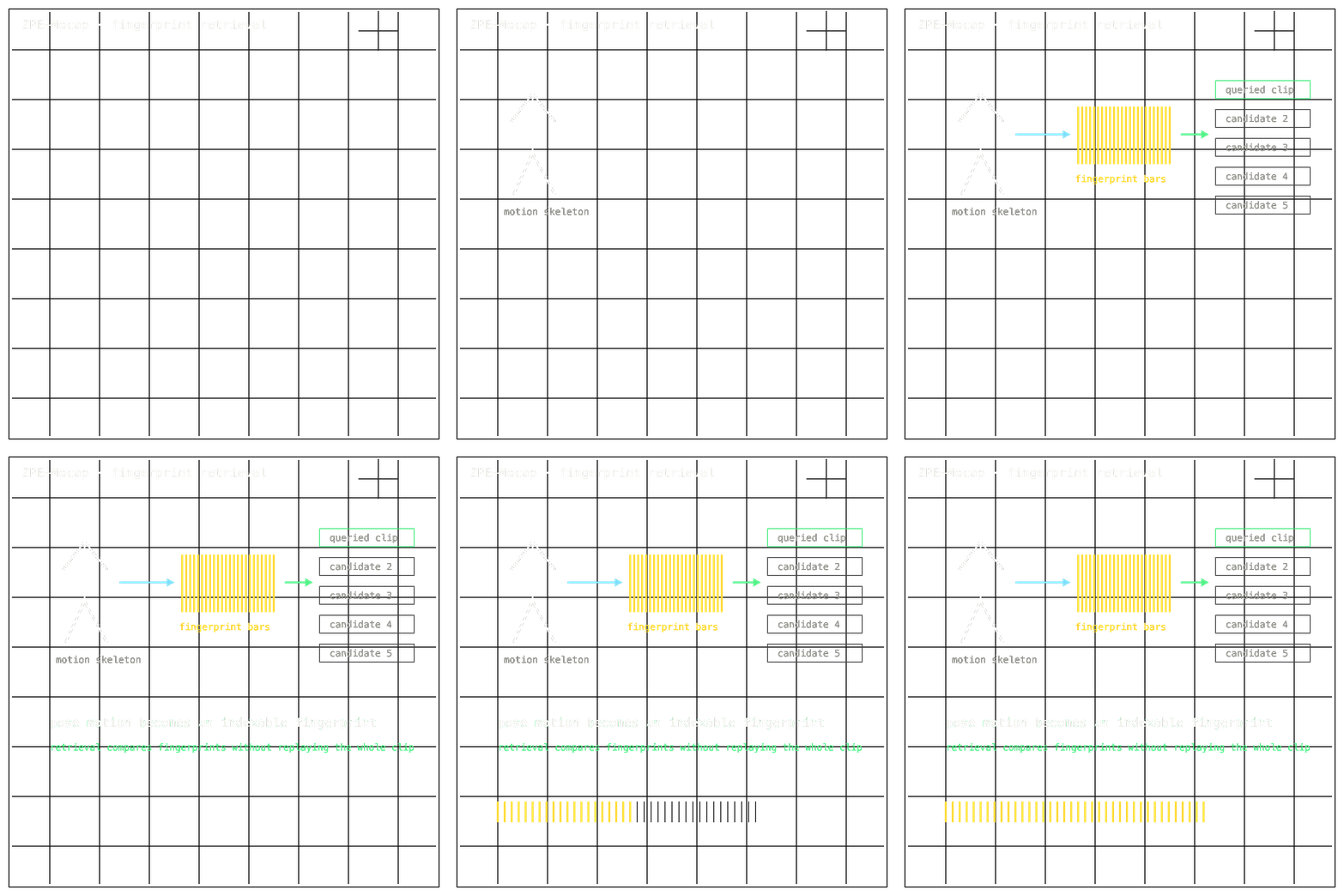
ZPE-Mocap fingerprints BVH skeletal trajectories into a small retrieval index. The public evidence is same-source held-out-window search, not cross-actor or cross-clip movement identity. The research queue now tests preservation under retargeting, corruption, repair, and failure localization.
05.3 · BENCHMARKSGATE-BLOCKED EVIDENCE
GateBlockedcustody
Public slice0.583R@10
Query p500.826ms
Next queue5branches
Scope: local fixture evidence only. Cross-clip identity, storage economics, standardization, and commercial readiness are not claimed.
06 · MEASUREMENTAUTHORITY GATE
Every metric remains below the sovereign gate, so no broader claim moves.
06.1 · AUTHORITY STATUS · CROSS-CLIP MOVEMENT IDENTITY
Evidence: 2026-06-13/14 GPD branch receipts keep the label BLOCKED_BY_EVIDENCE_CUSTODY. Current candidates are not authority-ready until source-excluded cross-clip or paired-retarget tests beat serious baselines.
07 · KEY METRICSRESEARCH FLOOR
07.1 · GATE LABEL
blocked
BLOCKED_BY_EVIDENCE_CUSTODY · no claim upgrade
07.2 · BASELINE PRESSURE
raw263
still stronger on the executable authority slice · must beat it
07.3 · QUERY p50
0.826ms
same-source fixture only · not cross-clip authority
07.4 · QUEUE STATUS
1-13
local branches exhausted · new research required
07.5 · CLAIM UPGRADE
none
no product, standard, compliance, or storage-economics claim · gate first
08 · RETRIEVAL SCOPEWHAT THE BLOCKER MEANS
The gate is blocked by evidence custody, not rescued by local wins.
08.1 · WHAT THE EVIDENCE ANCHORS
The public evidence anchors a bounded same-source retrieval path, fixture-level receipts, and a repeatable local harness. That is useful engineering, but it is not the sovereign primitive.
The next gate must exclude same-source leakage and test whether movement identity survives different clips, actors, retargeting, noise, and edits. Raw263, topology descriptors, learned motion baselines, and simple contact heuristics remain live competitors.
08.2 · HONEST BLOCKER
Honest Blocker ·
No authority-ready cross-clip identity. No semantic action retrieval. No storage-economics claim. No commercial release posture. The current label stays BLOCKED_BY_EVIDENCE_CUSTODY until paired data, pinned baselines, ablations, and source-excluded receipts exist.
09
The next win must be a receipt, not a slogan.
09.1 · THE AMBITION
Movement identity here means a representation that preserves what a body is trying to maintain, how local parts cooperate, and whether that movement survives body change or damage. If that proves useful, the commercial wedge is likely retarget QA, repair, or archive audit before general search.
09.2 · WHAT WORKS NOW
Working today: bounded same-source index, reproducible receipts, branch harness, and a falsification-ready GPD queue.
09.3 · WHAT'S STILL OPEN
Still open: paired retarget data, source-excluded cross-clip identity, pinned learned baselines, ablations, and authority custody.
09.4 · RETARGET QA · IF GATE PASSES
A changed body gets a preservation receipt
The strongest commercial path is not generic search. It is a retarget QA receipt that predicts whether contact, end-effector intent, and body-relative constraints survived a skeleton change better than raw263 or simple heuristics.
09.5 · REPAIR · IF GATE PASSES
Damaged clips repair toward movement form
A pattern-memory branch would test whether corrupted or missing motion can be repaired toward the same movement class instead of merely smoothed. It lives or dies against interpolation, learned repair, and contact fidelity.
09.6 · IDENTITY · IF GATE PASSES
Search survives corruption and body change
The identity branch only matters if it retrieves the same movement under noise, occlusion, time warp, mirror, and retargeting while excluding same-source shortcuts. Clean retrieval wins alone do not promote the lane.
09.7 · DEBUGGING · IF GATE PASSES
Failures localize to body parts
The multi-scale graph branch asks whether local limbs can share error signals and identify where a motion failed. If per-joint thresholds do the same job, the biological framing adds no value.
09.8 · PROVENANCE · IF GATE PASSES
Lineage stays separate from identity
Assembly-history work is useful only as audit hygiene unless it separates source, derivative, and coincidentally similar motion better than hashes and raw sequence alignment. Provenance cannot rescue bad identity evidence.
10 · UPCOMING RESEARCHGPD HYPOTHESIS QUEUE
10.1 · MORPHOGENETIC RETARGETING RECEIPT
Test target preservation on changed bodies
Build paired source/retarget clips with quality labels. Pass only if attractor-frame or body-relative receipts predict good vs bad retargets better than raw263, topology, contact heuristics, and learned QA baselines. Kill it if raw263 plus simple heuristics explain the same failures.
10.2 · PATTERN-MEMORY MOTION REPAIR
Repair damaged clips without losing form
Corrupt LaFAN1, AMASS, or CMU clips with dropout, noise, and missing spans. Pass only if the codec preserves movement class and contact realism better than interpolation and learned repair at comparable error. Kill it if outputs are smooth but movement-wrong.
10.3 · ERROR-CORRECTING MOTION IDENTITY
Stress identity under corruption
Run a source-excluded stress ladder across noise, time warp, mirror, occlusion, and retargeting. Pass only if identity retrieval improves across several corruption families against raw263, topology, DTW, and learned embeddings. Kill it if it re-encodes actor or source signatures.
10.4 · MULTI-SCALE COMPETENCY GRAPH
Localize where the movement failed
Model joints and limbs as local agents sharing an error budget. Pass only if the graph localizes injected or real retarget faults faster and more accurately than per-joint thresholds, topology QA, or engine debug signals. Kill it if it is just a nicer visualization.
10.5 · ACTIVE-INFERENCE RETARGET QA
Score bad retargets as prediction error
Train a source-excluded movement-program model and use likelihood or free-energy-style error as QA. Pass only if AUROC on good vs bad retargets beats raw distance and simple geometry. Kill it if the score mostly tracks skeleton topology instead of movement quality.