
Measured product lead custody receipt.
github.com/Zer0pa/ZPE-VideoRESEARCH-READY
LIVE
GPD BRANCHING OPEN
What The Model Saw, Not Just What It Said
A perception-receipt research lane for AI video pipelines · ZPE-Video · GPD multi-hypothesis exploration · github.com/Zer0pa/ZPE-Video
Live experiment. Not a release. Ambition headlined. Claims bounded.
Video AI often tells you what it decided, not what it saw.
ZPE-Video is testing whether a model's visual decision can leave a useful receipt: the object, frame, state, and context that made the decision possible.
The work is still research. Cross-runtime receipts give us a starting signal, but the hard question is ahead: what has to be preserved so a person can audit a machine's view of a moving scene?
01 · THE GAPOPEN RECEIPT QUESTION
An AI processes video — but the right evidence object is still being tested.
02 · MARKETSADJACENT FORECASTS
Adjacent AI-video and provenance markets · research context only; no adoption, compliance, or legal-sufficiency claim.
03 · VALUE
$39.7B
Content provenance is growing; ZPE-Video is testing a bounded perception-receipt layer beneath that infrastructure, not replacing it.
04 · INSIGHT
What AI saw in the video is becoming testable.
05.1 · CURRENT TECHSCATTERED TRACE STATE
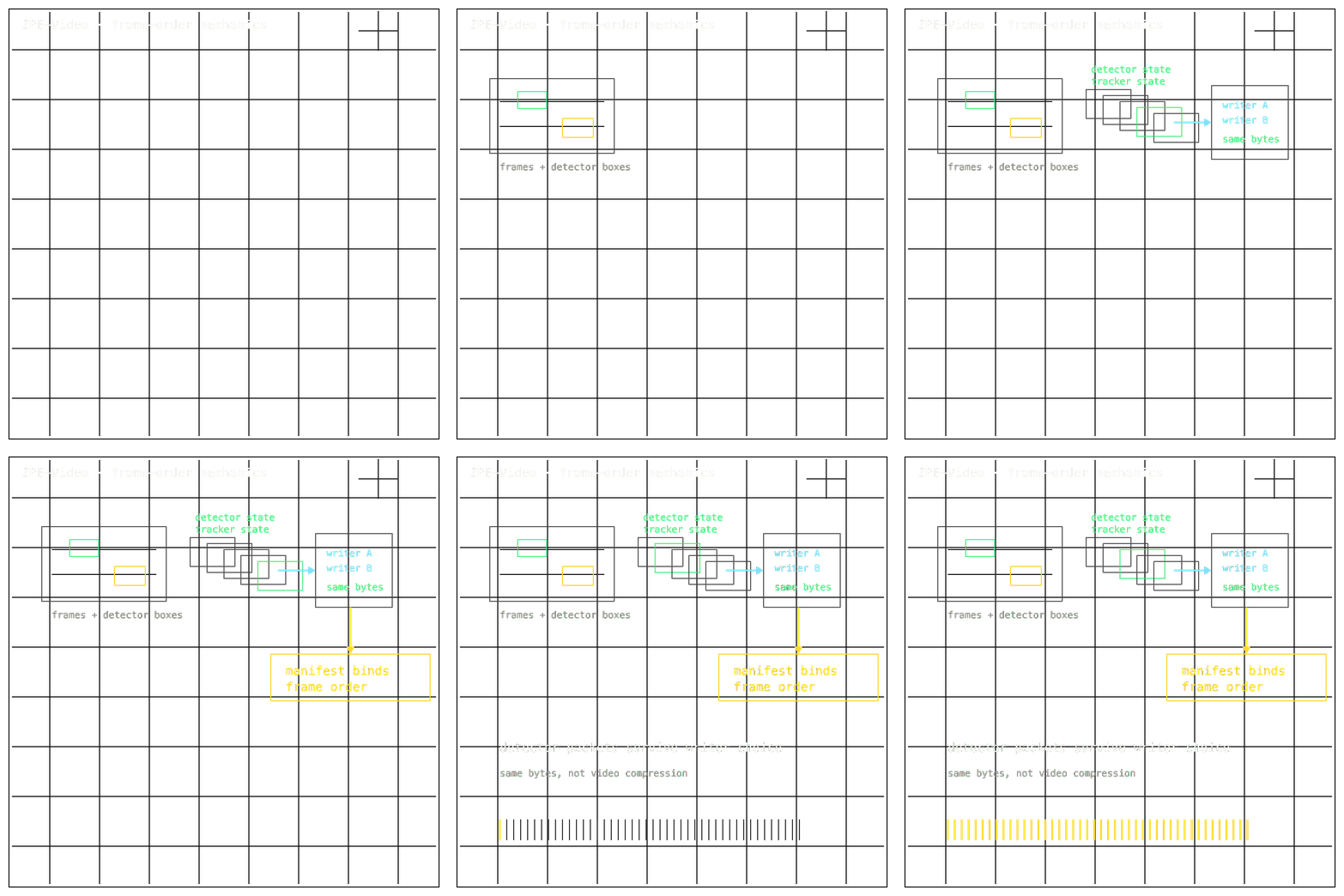
Perception traces from AI video pipelines scatter across Parquet, JSON, pickle, and MCAP containers. The open question is whether a smaller receipt profile can preserve enough state for bounded audit disputes.
05.2 · OUR TECHRECEIPT HYPOTHESIS
zpe-video tests whether detector/tracker state can become a re-derivable evidence object. The current lane uses fixed receipts, manifests, reject vectors, baselines, and GPD branch scoring before any public product claim.
05.3 · RUN EVIDENCELOCAL GATE PACKET
Vector corpus20local cases
Real traces5detector/video
Rejects8fail correctly
CI gateOPENpublic OS run
Run note: local cross-runtime evidence is promising; public macOS/Linux CI remains the blocker.
06 · MEASUREMENTRESEARCH VALIDATION
Receipt evidence is tested through bytes, baselines, branches, and blockers.
06.1 · COMPARATIVE RECEIPT VALIDATIONLOCAL CROSS-RUNTIME SIGNAL
Local evidence says three runtimes match on 20 vectors, including 5 real traces. The page remains research-ready until public two-OS CI and baseline pressure close.
07 · RUN SIGNALSGPD BRANCH EXPLORATION
07.1 · VECTOR CORPUS
20LOCAL CASES
Synthetic and real-trace vectors · research packet only
07.2 · REAL TRACES
5VIDEO TRACES
Detector-derived inputs · public CI still open
07.3 · WRITERS
3
Python / Node / Rust · local match reported
07.4 · REJECTS
8
Invalid vectors rejected · gate evidence only
07.5 · COMPRESSION
KILLED
Raw struct+zlib is smaller; receipt discipline survives.
08 · DETERMINISMRESEARCH GATE
Cross-runtime bytes are promising, but not public-gate closed.
08.1 · WHAT DETERMINISTIC MEANSRECEIPT SCOPE
Deterministic now means a research target: the same detector/tracker input plus the same wire-format spec should produce a byte-identical perception receipt across runtimes. Local Python, Node, and Rust evidence is strong; public macOS/Linux CI is the remaining blocker. The scope is the record, not computer vision truth.
08.2 · HONEST BLOCKER
Honest Blocker ·
The receipt carries detector and tracker state — boxes, labels, CRCs, manifest binding. It does not prove detector correctness, reconstruct pixels, or establish legal chain of custody. Compression is not the wedge. The next work is public CI, branch scoring, and stronger baseline pressure.
09
WHAT THE MODEL SAW, as a research question.
09.1 · THE AMBITION
The ambition is not to compete with video codecs. It is to test whether detector/tracker state can become a reproducible receipt: enough to answer bounded perception disputes without pretending to reconstruct the whole video.
09.2 · WHAT WORKS NOW
Working locally: three-runtime receipt evidence across 20 vectors, including 5 real detector traces.
09.3 · WHAT'S STILL OPEN
Still open: public macOS/Linux CI, causal-state benchmark, branch scoring, and no public claim upgrade.
09.4 · MODEL REGRESSION · WEDGE TEST
What changed between detector versions?
The first commercial branch asks whether a receipt can show per-video detector deltas more clearly than dashboards, screenshots, or raw logs. If it cannot beat those incumbents, the branch narrows or dies.
09.5 · OBJECT PRESENCE · BOUNDED DISPUTE
Can a receipt answer a narrow question?
The current profile is small on purpose: object present, count, label, frame, and box. It is not whole-video truth. The branch survives only if those fields answer a real dispute without hidden logs.
09.6 · PROVENANCE · WRAPPER LAST
Can perception state bind into provenance?
C2PA and PROV are treated as baselines and envelopes, not novelty. The bridge is tested only after the payload earns value through answerability, conformance, and baseline resistance.
09.7 · INTEGRITY · REJECTION BEHAVIOR
Invalid receipts should fail loudly.
Reject vectors are part of the research surface. The goal is not only matching good bytes; it is refusing malformed state with clear errors before downstream systems treat bad detector records as evidence.
09.8 · GOVERNANCE · RESEARCH ONLY
Can audit language stay bounded?
Governance remains a research horizon, not a claim. The page freezes legal and compliance language until receipts, baselines, provenance boundaries, and public CI evidence justify narrower wording.
10 · UPCOMING RESEARCH2026-06-15 GPD BRANCH QUEUE
10.1 · CAUSAL STATE · MINIMAL RECEIPT
Minimal state, not raw output
Test whether a receipt keeps only decision-sufficient fields for a declared task. Kill if COCO JSON plus hashes gives the same answerability and review value.
10.2 · LIGHT CONE · COMPETENCE BOUNDARY
A receipt must know its limits
Turn PerceptionDisputeProfile into an executable boundary: answer presence, count, and zone where supported; reject identity or detail claims outside scope.
10.3 · MARKOV BLANKET · EVENT BOUNDARY
Boundary events over frame logs
Test Markov-blanket receipts for entry, exit, occlusion, tripwire, and prediction-error moments. Continue only if sparse state beats dense logs.
10.4 · HOMEOSTASIS · REGRESSION DELTA
Model drift as evidence
Compare detector versions through decision-relevant deltas, not aggregate scores. Win condition: faster localisation of buyer-relevant regressions than dashboards.
10.5 · COLLECTIVE CONSENSUS · DISAGREEMENT MAP
Where detectors disagree
Run detector and tracker sets, then receipt agreements, conflicts, and uncertainty zones. Kill if confidence metrics find the same hard cases with less complexity.