
Measured product lead custody receipt.
github.com/Zer0pa/GenesisRESEARCH-READY
LIVE
SOURCE OPEN
3D Sriyantra Computation Lattice
Two independent builds, 31,560 matching hashes, one canonical SHA · Genesis · github.com/Zer0pa/Genesis
Live experiment. Not a release. Ambition headlined. Claims bounded.
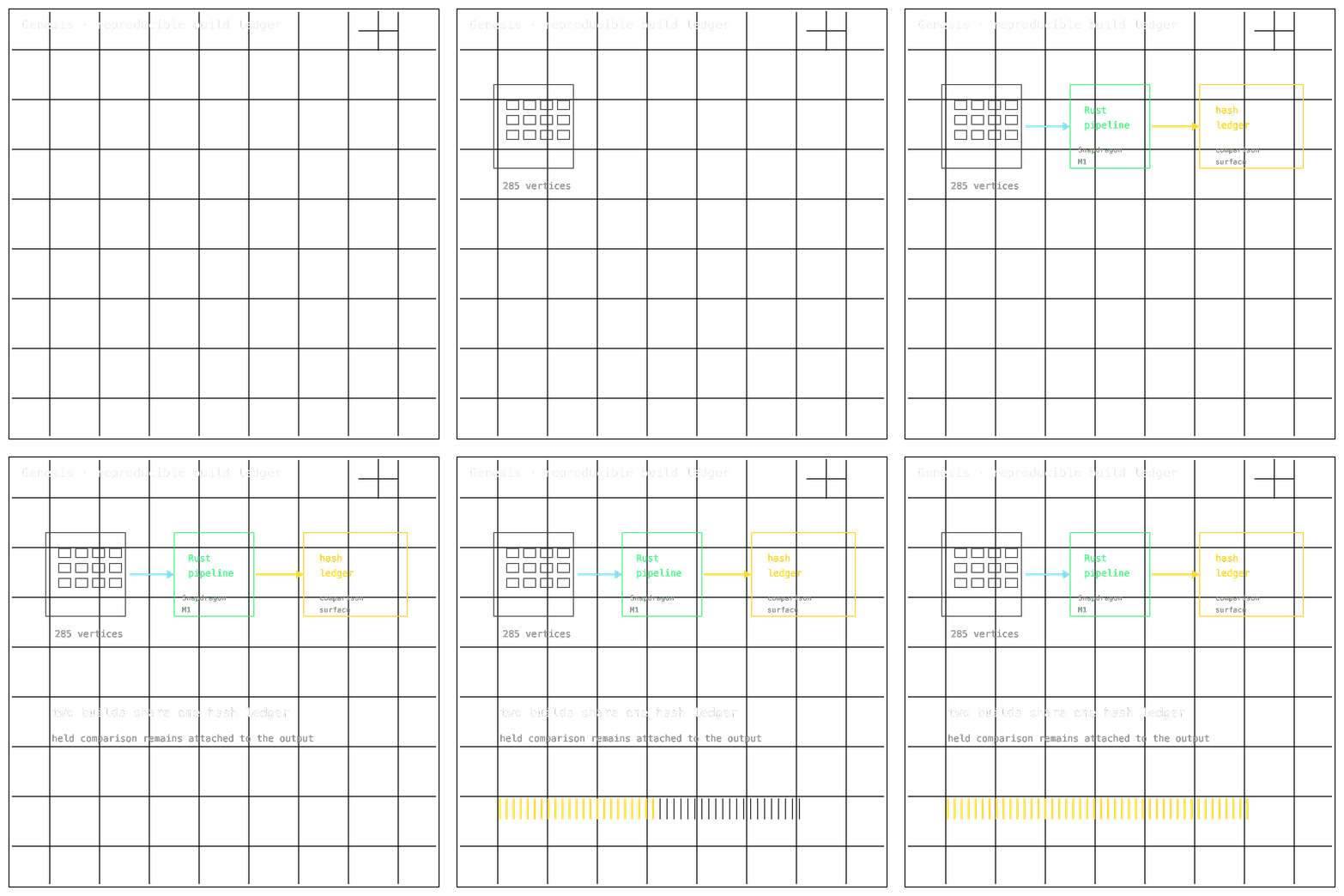
A computational result is only as real as the next person's ability to reproduce it. Genesis takes a non-trivial Rust pipeline over a 285-vertex geometric substrate, compiles it twice on different machines — one Snapdragon 8 Elite, one Apple M1 — and shows that every one of 31,560 Phase 0 hashes agrees on the same canonical signature.
74 evidence cells pass with zero divergences. Three of four pre-registered comparisons are settled; one symmetry test is held to v2.0.
01 · THE GAPNO RECEIPT
Build the same code twice independently; no receipt proves both got the same answer.
02 · MARKETSADJACENT FORECASTS
Five neighbouring markets all assume one floor that almost nobody checks: rebuild a computation and get the identical bytes back.
03 · VALUE
$74.2B
The 2030 digital-engineering market — built on a rebuild sameness nobody has been counting.
04 · INSIGHT
Build it twice. Get the same answer; that's the proof.
05.1 · CURRENT TECHASSUMED, NOT PROVEN
Containers, seeded randomness, floating-point discipline, and tolerance thresholds reduce drift between two builds of the same scientific code. They do not produce a public, counted answer to the plain question: did the bytes match?
05.2 · OUR TECHTWO BUILDS, ONE SHA
Genesis runs a pure-rational Rust pipeline — every math-path value a BigRational, no floating-point — over a 285-vertex D6 substrate. The same source is compiled twice: once on a Snapdragon 8 Elite, once on an Apple M1. Both builds produce 31,560 Phase 0 hashes that agree on a single canonical signature. Across 74 evidence cells, zero divergences.
05.3 · BENCHMARKSV1.0 EVIDENCE CHAIN
Cells74/74PASS
Hashes31,560Phase 0
Divergence0cells
DM33/4settled
Scope: v1.0 only · no PyPI distribution yet · the D6-vs-C3 Z2 symmetry check is held to v2.0.
06 · MEASUREMENTTWO-BUILD HASH AGREEMENT
74 evidence cells. Two builds. 31,560 hashes agree.
06.1 · COMPARATIVE VALIDATION · PHASE 0 HASH AGREEMENT
Apple M1 and Snapdragon 8 Elite return one canonical signature across 31,560 hashes. solve_h2.json and the K2 step-30 trajectory match byte-for-byte. Three of four pre-registered comparisons are settled; the D6-vs-C3 symmetry observable is deferred to v2.0.
07 · KEY METRICSMEASURED RESULTS
07.1 · 74 EVIDENCE CELLS
74/74
Evidence cells closed · zero divergences across both builds
07.2 · PHASE-0 HASHES
31,560
Identical hashes on two independent builds · byte for byte
07.3 · CANONICAL SHA
1
One canonical signature · across all 31,560 hashes
07.4 · PRE-REG COMPARISONS
3/4
Pre-registered comparisons settled · the fourth held to v2.0
07.5 · K2 PARITY
S30OK
One step depth agrees across builds · the next three still pending
08 · DETERMINISMBYTE-IDENTICAL ACROSS BUILDS
Two builds. One SHA. 31,560 hashes agree.
08.1 · WHAT DETERMINISTIC MEANSPER-BUILD, PER-CELL
Two independent builds of the same Rust pipeline — Snapdragon 8 Elite and Apple M1 — run against the same 285-vertex D6 substrate and return the same verify.json signature across 31,560 Phase 0 hashes. Cross-build parity is confirmed for solve_h2.json and for K2 at step 30.
Every math-path value is BigRational; no floating-point is involved on the math path. Byte-exactness is verified per cell and per build against declared canonical hashes. Genesis does not claim all architectures, all step depths, or v2.0 symmetry parity, and says so explicitly.
08.2 · THE FIDELITY GAP
Honest Blocker ·
Bounded to v1.0 receipts. No PyPI package: the existing genesis name is unrelated, zer0pa-genesis is absent. The Cargo/Rust source is not yet substantiated in public form. The v1.0.0 tag has no Release object. The D6-vs-C3 Z2 symmetry observable and step-20/40/50 host widening remain open.
09
WHEN A COMPUTATION keeps its identity.
09.1 · THE AMBITION
A computational result should mean the same thing on the second machine, the next year, and in the next reviewer's hands. Genesis narrows scope until that sameness is countable rather than promised, so downstream science and engineering can finally point to one stable object instead of an approximate rerun.
09.2 · WHAT WORKS NOW
What holds today: 31,560 Phase 0 hashes match across two independent builds, with zero divergences across 74 evidence cells.
09.3 · WHAT'S STILL OPEN
Still open: published Cargo source, the D6-vs-C3 symmetry test, step-20/40/50 host widening, and a PyPI distribution.
09.4 · BUILD VARIANCE · NEAR-TERM (12–24 MO)
Rebuild variance gets a counted number
A simulation team that today writes “results are reproducible to within tolerance” gains a sharper line to draw. When 31,560 hashes either match or do not, internal review meetings about rebuild drift stop being narrative and start being a count.
09.5 · CROSS-PLATFORM · NEAR-TERM (12–24 MO)
“It worked on my machine” stops winning
A scientific collaboration that hands a pipeline between an Apple M1 laptop and an Android-class ARM handset can now demand the same canonical answer from both. Platform difference stops being an automatic excuse for unexplained divergence between collaborators.
09.6 · SCIENTIFIC CHAINS · MID-TERM (24–48 MO)
Computational papers gain a stable referent
A reviewer assessing a computational claim can be pointed at a retained hash chain rather than a re-run that approximates the original. The paper, the figure, and the underlying computation share one identity that later experiments can attach to.
09.7 · PROCUREMENT · MID-TERM (24–48 MO)
Engineering reviews compare artifacts, not summaries
A release-review board signing off on a regulated computational deliverable can compare retained hashes between candidate builds instead of reading prose. Deferred questions stay disclosed alongside the receipt; identity becomes checkable without trusting a vendor narrative.
09.8 · COMPUTATION IDENTITY · PARADIGM (48 MO+)
A computation earns a stable identity
When the same non-trivial computation can be rebuilt on independent hardware years apart and return identical bytes, regulators, courts, and scientific reviewers gain something they have never had: a computational result they can point to the way they point to a sample on a scale.