Measured product lead custody receipt.
github.com/Zer0pa/ZPE-Diagram
RESEARCH-READY
LIVE
RESEARCH-READY
Diagrams That Remember Their Source
Source-paired diagram witness · ZPE-Diagram · Mermaid / D2 evidence floor · public claim gate blocked · github.com/Zer0pa/ZPE-Diagram
Live experiment. Not a release. Ambition headlined. Claims bounded.
Diagrams are not just pictures. A box, arrow, curve, and label carry grammar: what connects, what depends, what was drawn on purpose.
ZPE-Diagram asks whether that grammar can travel with the rendered image. The source says what the author meant; the render shows what the tool produced; the receipt should make the difference visible.
The early work is promising, but deliberately bounded. Mermaid and D2 cases give us a floor. Real diagram objects, DOM checks, and corpus-scale structure decide whether this becomes more than a witness.
01 · THE GAPEXPORT AMNESIA
A diagram exported as an image can forget the structure that made it useful.
02 · MARKETSWEDGE MAP
Wedge order is evidence-first: docs CI and renderer validation before standards, compliance, or broad interchange language.
03 · VALUE
CIwedge
The credible buyer path is export-fidelity CI for docs teams, not a finished standards or codec claim.
04 · INSIGHT
A diagram's identity is the source-to-render relation, not just the pixels.
05.1 · CURRENT TECHPICTURE PASSES
Renderers usually answer a narrow question: did the source produce a viewable SVG or PNG? That is useful, but it does not prove the rendered artifact still preserves node identity, edge meaning, label custody, or source-linked structure.
05.2 · OUR TECHWITNESS THE EXPORT
ZPE-Diagram now points at a source-paired witness: parse the diagram source, inspect the rendered SVG, compare the two, and refuse mismatches such as changed labels or source hash drift. This is a partial mechanism toward diagram identity, not a public authority packet.
05.3 · BENCHMARKSEVIDENCE FLOOR
Mermaid20docs
D22/2CLI
Mutationsrefusedgate
Publicblockedclaim
Receipts: Mermaid source-paired corpus harness, D2 interchange probe, export-fidelity CI policy. The sovereign gate remains fail-closed.
06 · MEASUREMENTSOURCE-PAIRED CI
The local gate can refuse known drift; the broad diagram primitive is not proven.
06.1 · RUN SIGNALSMERMAID / D2
Current signals are buyer-shaped CI evidence. They do not prove broad interchange, source-lost recovery, standards readiness, or compression.
07 · KEY METRICSRESEARCH FLOOR
07.1 · CORPUS FLOOR
20
MIT Mermaid docs cases selected for source-paired harness evidence.
07.2 · D2 PROBE
2/ 2
Real D2 CLI SVG cases accepted; label mutation and source hash mismatch refused.
07.3 · CI POSTURE
internal
Cross-renderer buyer CI policy passes internally; public claim remains blocked.
07.4 · SOVEREIGN GATE
blocked
Typed object profile, DOM validator, original-structure metrics, and real corpus denominator still required.
07.5 · SIZE CLAIM
none
No compression, legal, standards, enterprise, or developer-ready claim is earned.
08 · DETERMINISMFAIL-CLOSED
Useful evidence exists only where the source, renderer, and SVG are kept together.
08.1 · WHAT DETERMINISTIC MEANSWITNESS + REFUSAL
Determinism here means the gate can replay a declared source-render pair and explain why it accepts or refuses it. The current mechanism is strongest when the source is known. It should not be stretched into source-lost recovery, diagram understanding, broad interchange, or archive authority.
08.2 · THE BLOCKER
Honest Blocker ·
Full sovereign gate false. The lane still needs a typed diagram object/profile, a DOM validator, original-structure metrics, and a real corpus. Dot, PlantUML, and source-lost references remain parked until independent receipts exist.
09
DIAGRAMS with a witness.
09.1 · THE AMBITION
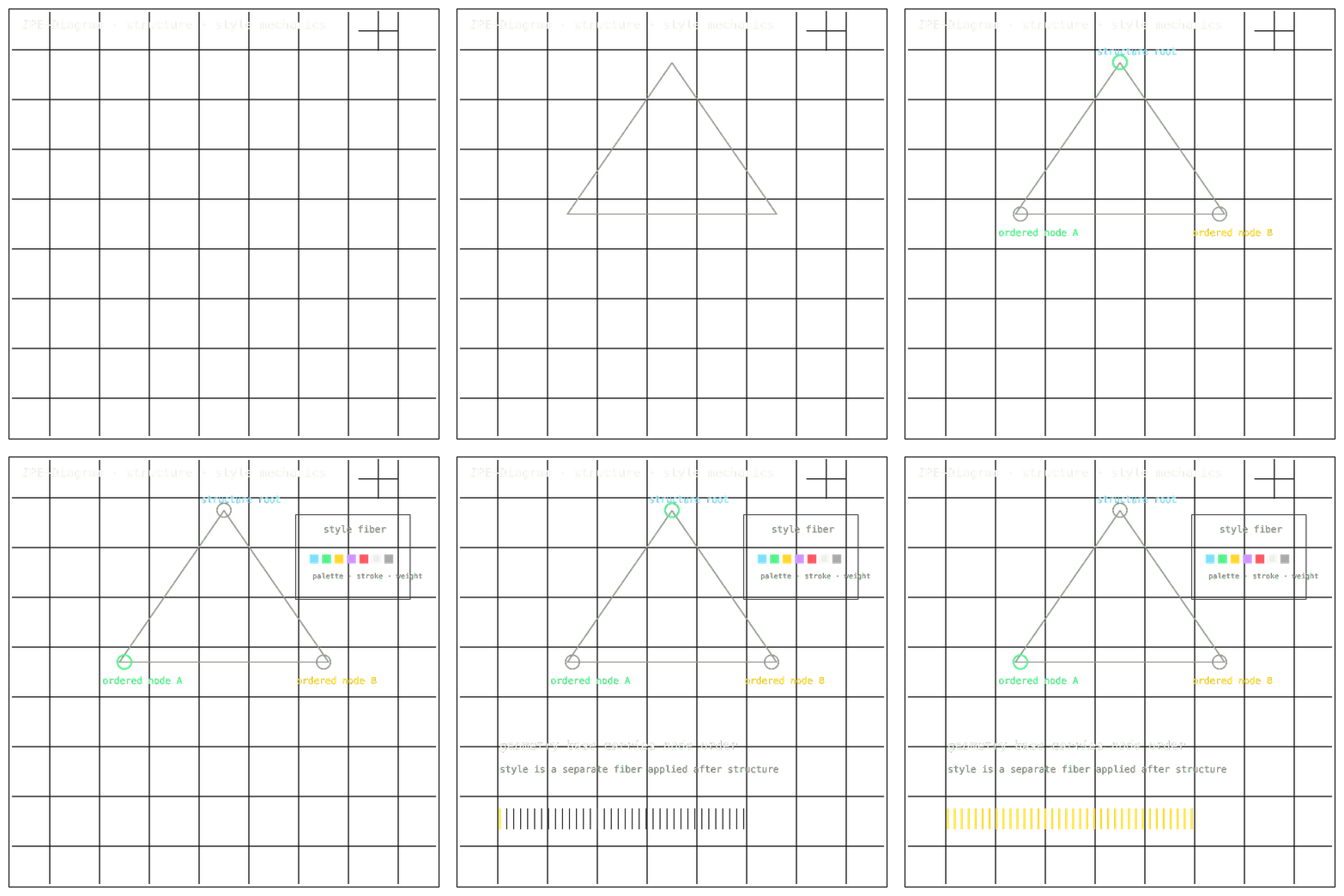
The ambition is a defensible diagram-identity primitive: source, rendered geometry, labels, style, draw order, and provenance are bound tightly enough that a docs team can catch silent semantic drift before a diagram ships.
09.2 · WHAT WORKS NOW
Working now: source-paired CI can accept known Mermaid / D2 evidence and refuse controlled mismatches.
09.3 · WHAT'S STILL OPEN
Still open: typed profile, DOM baseline, real corpus denominator, and source-lost falsification.
09.4 · DOCS CI · NEAR-TERM
Docs teams catch diagram drift
A pull request changes a Mermaid or D2 diagram. The gate checks whether the rendered SVG still matches source identity, labels, and edges before the documentation site ships.
09.5 · RENDERERS · NEAR-TERM
Renderer upgrades get canary tests
Teams can test whether a Mermaid, D2, or future renderer upgrade changed diagram meaning, not merely whether it produced a visually plausible file.
09.6 · AI DOCS · TESTABLE
AI-generated diagrams face semantic refusal
Generated diagrams can be accepted only when source, labels, and rendered structure agree. Syntax-valid but semantically decoupled diagrams should fail the witness.
09.7 · PROVENANCE · MID-TERM
Diagram review moves from pixels to custody
The useful diff is not only what moved on screen. It is which source object, renderer version, label, edge, and witness changed between two diagram states.
09.8 · ARCHIVES · GATED
Standards language waits for receipts
Regulated archives and standards bodies are plausible later users only after the corpus, DOM baseline, and provenance receipt survive falsification.
10 · UPCOMING RESEARCHGPD QUEUE
Five branches must now attack the sovereign diagram witness gate.
10.0 · SELECTION RULE
These branches came from the Diagram research folder because they are closest to the core USP, executable with current agents, commercially pointed, falsifiable, and harder for a DOM or pixel baseline to subsume.
10.0 · PASS RULE
Continue only if the witness beats source hash, DOM inspection, and pixel diff on real diagrams.
10.0 · KILL RULE
Kill or narrow any branch that only creates prettier receipts without catching unique semantic failures.
10.1 · BIOELECTRIC SETPOINT
Diagram homeostasis as a witness
Test whether a diagram has a source-defined target state. Kill it if source hash, renderer output, or DOM checks catch the same failures with less machinery.
10.2 · SEMANTIC DECOUPLING
Find orphaned diagram meaning
Score labels, nodes, and edges that render but lose source custody. Kill it if precision is weak or ordinary graph parsing exposes the same drift.
10.3 · D2 DENOMINATOR
Scale the proof past two cases
Expand D2 source-paired fixtures into a real corpus with mutation controls. Kill broad D2 language unless the denominator survives routine renderer variation.
10.4 · PROVENANCE LINEAGE
Bind diagram source to custody
Create a receipt linking source, renderer, SVG, witness, and refusal reason. Kill it if generic provenance already provides the same buyer value.
10.5 · RENDERER CANARY
Catch upgrade semantic drift
Run renderer-version canaries over source-paired corpora. Kill it if pixel diff and source diff explain every meaningful failure.