Measured product lead custody receipt.
github.com/Zer0pa/CuneiformRESEARCH-READY
LIVE
P5 NO-GO
Five thousand years of writing, searchable by its shape.
Cuneiform morphology, kept honest · Gnosis-Cuneiform · PyPI cuneiform-control v0.1.0 · github.com/Zer0pa/Cuneiform
Live experiment. Not a release. Ambition headlined. Claims bounded.
Cuneiform is one of the oldest writing systems on earth — five thousand years of pressed marks in clay.
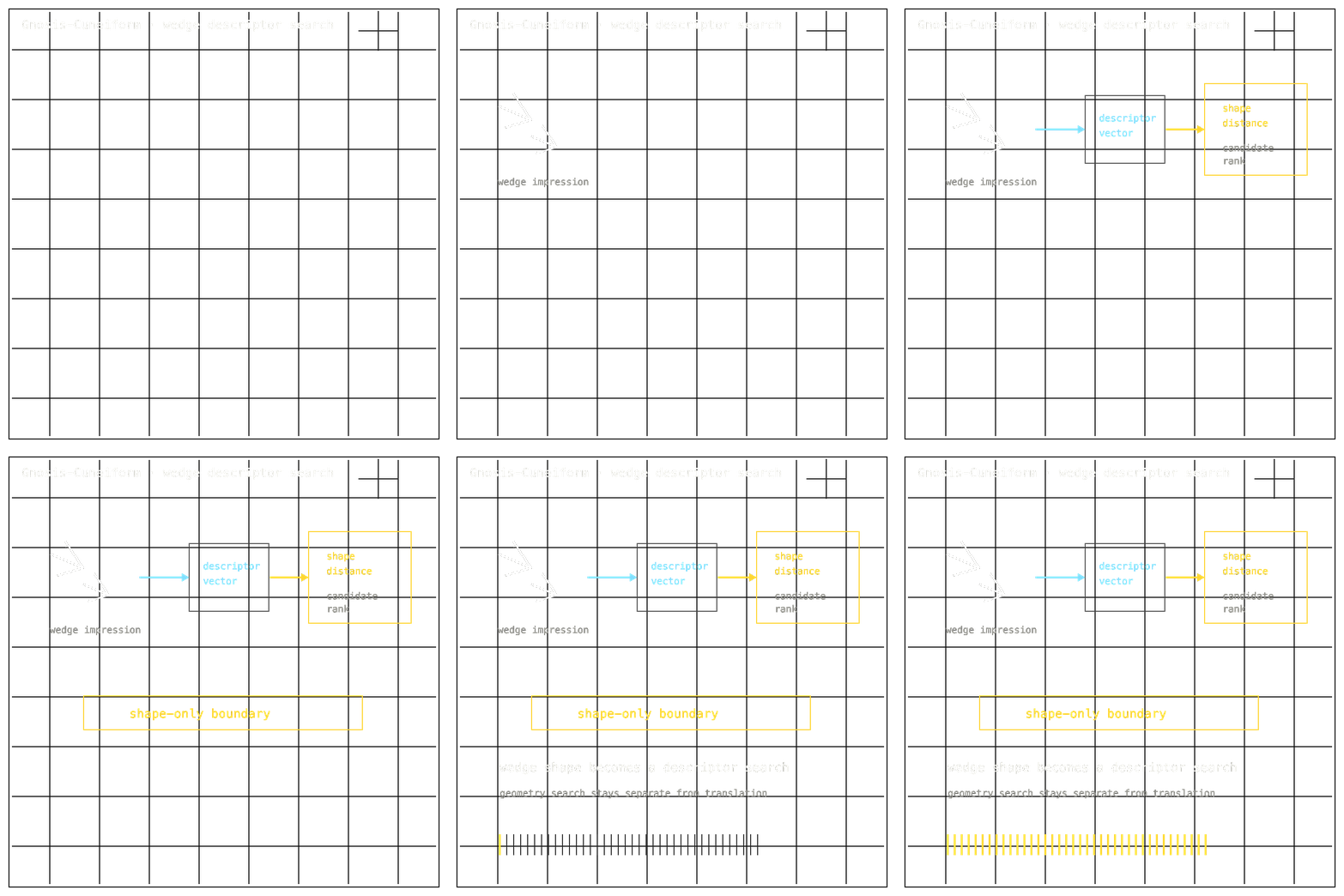
Gnosis-Cuneiform measures the geometry of those signs so archives, classrooms, and museums can look across collections by shape. The first attempt at a governing classifier scored 0.021916 against a 0.6 target, and the score stays on the record. This page is shape infrastructure, not a reading claim, and the image-bearing corpora stay outside the public pack.
01 · THE GAPSUCCESS-ONLY RECORD
Experts catalogue cuneiform sign by sign; cross-collection search still begins from human memory.
02 · MARKETSADJACENT FORECASTS
source: adjacent research-infrastructure and heritage categories. Sign-shape search is one underbuilt workflow inside them, not a commercial reading service.
03 · VALUE
$8.1B
Heritage digitization '30; cross-collection sign-shape search is one underbuilt workflow inside that spend.
04 · INSIGHT
Cuneiform sign geometry a measurable signal.
05.1 · CURRENT TECHMEMORY-BOUND CATALOGUES
Digitised tablets become images and catalogue entries. A scholar asking which signs look like this wedge pattern still walks between collections, emails curators, and stitches the answer together from human recall and PDF appendices.
05.2 · OUR TECHPUBLIC CONTROL PACK
The cuneiform-control package on PyPI carries the morphology boundary in public: shape metrics, manifest checks, source policy, and the below-target classifier score recorded plainly at 0.021916. Anyone can install it, replay the manifest, and inspect the result without releasing image-bearing corpora or claiming text recovery.
05.3 · BENCHMARKSPHASE-2 RESULT STATUS
P5 1NN check0.021916NO-GO
Manifest5/5PASS
Schema0errors
PyPIv0.1.0
Verdict: Governing classifier below target · manifest passes against the SHA-pinned upstream tablet artefact.
06 · MEASUREMENTPHASE-2 RESULT LEDGER
One classifier score against one chosen target.
06.1 · RESULT LEDGER · PHASE-2 STATUS
Phase 2 governing score 0.021916 against a 0.6 target. P6 and P7 diagnostics report alongside but do not repair the result. Manifest passes 5/5 against the SHA-pinned 9.28 MB upstream tablet artefact.
07 · KEY METRICSPACK STATUS
07.1 · GOVERNING 1NN CHECK
0.021916
Governing classifier · below 0.6 target, kept public
07.2 · MANIFEST INVARIANTS
5/5
Manifest invariants pass · stdlib-only smoke runner
07.3 · P6 DIAGNOSTIC
0.038176
Diagnostic score only · does not repair the governing result
07.4 · PYPI CONTROL PACK
v0.1.0
cuneiform-control on PyPI · Apache-2.0, live 2026-05-04
07.5 · MANIFEST SHA-256
e4d85a…3daa24
9.28 MB upstream artefact · SHA-pinned, verified
08 · DETERMINISMREPLAYABLE PACKET
Public packet replay the same measured boundary.
08.1 · WHAT REPLAYS EXACTLYSHA-PINNED MANIFEST
Across two fresh installs, the Phase 2 score (0.021916) hashes identically. The pack validates 5 cross-field invariants with 0 schema errors against the SHA-pinned 9.28 MB artefact, stdlib-only on any Python 3.8+ host.
This is not scientific proof of text recovery: the smoke does not re-run the governing 1NN. It proves the public control pack still matches the recorded morphology boundary, byte for byte, so the failed result cannot quietly drift over time.
08.2 · HONEST BLOCKER
Honest Blocker ·
Manifest validation only: the smoke proves shape, not science. It does not repair the classifier result, recover cuneiform text, or release image-bearing corpora. Raw bytes remain private; Traditional-Knowledge protocols, museum image rights, and public-review limits apply. RELEASING.md and .gpd/STATE.md release-state drift pending.
09
Ancient sign shape search without reading claims.
09.1 · THIS LAB'S AMBITION
The ambition is applied infrastructure for the cuneiform world: measure the geometry of a sign once, then let it travel into catalogue lookup, cross-collection comparison, classroom teaching, and museum metadata — without ever claiming text recovery or releasing image-bearing tablets the field has agreed to protect.
09.2 · WHAT THIS IS
Shape-search infrastructure is public, the manifest passes, and the failed classifier score stays on the record.
09.3 · WHAT IT IS NOT
The governing classifier missed its 0.6 target; image-bearing corpora and release-state drift stay outside the pack.
09.4 · ARCHIVES · NEAR-TERM (12–24 MO)
Tablet archives gain shape lookup
A researcher chasing a wedge pattern across the British Museum, the Louvre, and CDLI no longer relies on memory and email. Sign geometry becomes a queryable field across catalogues, and the answer arrives before the trip is booked.
09.5 · TEACHING · NEAR-TERM (12–24 MO)
Cuneiform classrooms see sign families
A graduate seminar can group signs by visible form before any language claim enters the room. Students see how wedges relate to wedges, building intuition for variation across scribes, periods, and regions instead of memorising tables.
09.6 · CATALOGUING · MID-TERM (24–48 MO)
Museums describe signs by geometry
Curators add measured shape descriptors to tablet records alongside provenance and period. Discovery improves for the next generation of scholarship, and the metadata stays honest about what was photographed versus what was read.
09.7 · METHOD · MID-TERM (24–48 MO)
Heritage AI keeps its discipline
A loud public no-go score makes premature decipherment claims harder to publish unchallenged. Funders, reviewers, and journalists gain a reference for what restraint looks like when an early model misses the threshold its own authors chose.
09.8 · METHOD · PARADIGM (48 MO+)
Failed science becomes shared memory
Heritage scholarship gains a habit of preserving negative results with the same care as positive ones. A century from now, the next attempt on cuneiform morphology starts from a known floor, not from a forgotten draft, and the field learns faster because of it.