
Measured product lead custody receipt.
github.com/Zer0pa/ZPE-MusicRESEARCH-READY
LIVE
PHASE 10 OPEN
The Music Beneath The Sound
The score-identity receipt lane — what the composer wrote, not what the orchestra played · ZPE-Music · GPD Phase 10 open · github.com/Zer0pa/ZPE-Music
Live experiment. Not a release. Ambition headlined. Claims bounded.
Music is not only the sound that reaches a microphone. Before it is played, it is a score: notes, voices, articulations, repeats, and intent.
ZPE-Music starts there. It asks whether the written music can keep its identity through export, parse, compare, and replay without being flattened into audio.
The current receipts are strongest on real MusicXML score identity. That is the point of the lane: protect what the composer wrote before arguing about how any one performance should sound.
01 · THE GAPSCORE BECOMES SOUND
When a score is encoded as a waveform, the composer's intention disappears — it can't come back.
02 · MARKETSADJACENT FORECASTS
Symbolic-score archives have no published analyst category — MusicXML volume sits inside music-publishing and rights-management forecasts.
03 · VALUE
$10.8B
Music publishing grows; the symbolic-score archive sits unpriced inside publisher and rights workflows.
04 · INSIGHT
A waveform keeps the sound. a score keeps the music.
05.1 · CURRENT TECHCODECS EAT THE SCORE
DAWs encode audio. Streaming platforms deliver waveforms. AI music systems learn from recordings. The written structure beneath the sound — events, voices, articulation, expression — is outside every test. Codecs eat it and emit sound.
05.2 · OUR TECHKEEP THE SCORE
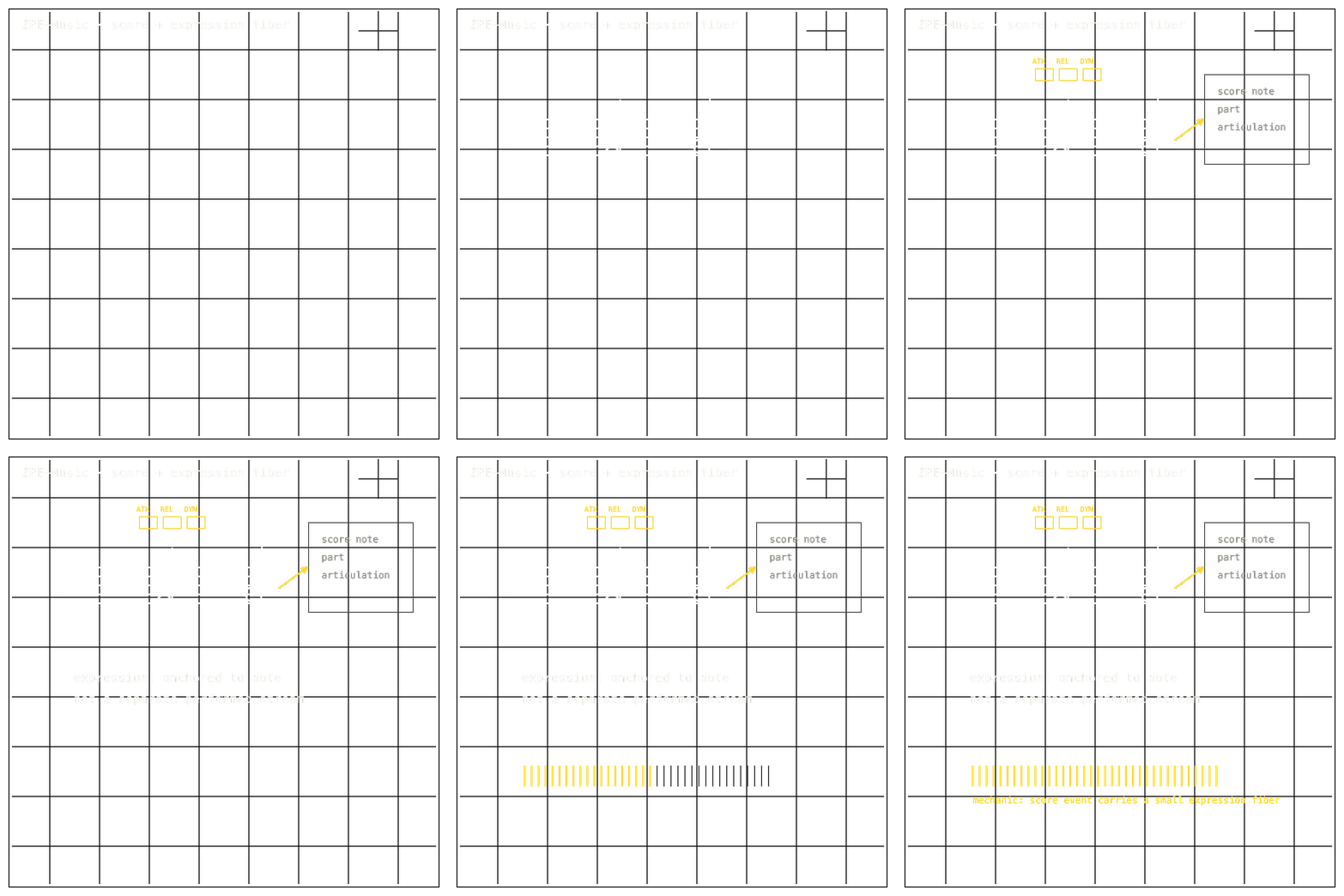
ZPE-Music now tests whether a score can carry a receipt-backed self boundary. The current mechanism parses MusicXML, encodes a canonical score identity contract, decodes, exports, reparses and compares canonical forms. It returns same, different or unsupported; silent relaxation is treated as failure.
05.3 · BENCHMARKSMUSICXML SCORE SURFACE
Corpus137of 220 admitted
Events116Kcanonical events
Grace79 / 79v0.2.1 same
Tests36full suite pass
Surface: bounded MusicXML contracts · public README claims remain frozen until product gates earn them.
06 · MEASUREMENTRECEIPT GATES
A score identity claim only counts when it survives export, reparse, collisions and baseline pressure.
06.1 · CURRENT RECEIPTSV0.1 DEFAULT + OPT-IN V0.2.1
identity_metrics.json + collision_matrix.json + Phase 9 receipts. Controlled revision fixtures showed signal, but the revision wedge is not promoted until a real or semi-real revision corpus passes. Source: github.com/Zer0pa/ZPE-Music.07 · CURRENT EVIDENCESCORE-IDENTITY RECEIPTS
07.1 · V0.1 CORPUS
137FILES
Admitted from 220 candidates
07.2 · EVENTS
116KEVENTS
Exact admitted count: 116,381
07.3 · GRACE IMC
79 / 79SAME
v0.2.1 opt-in grace corpus
07.4 · REVISION
20 / 20CTRL
Controlled signal only; real corpus open
07.5 · TESTS
36PASS
Full suite after grace schema upgrade
08 · CLAIM BOUNDARYRESEARCH-READY
The claim is score identity receipts, not universal music understanding.
08.1 · WHAT DETERMINISTIC MEANSPER-CONTRACT, SCORE NOT SOUND
Deterministic here means the same declared score contract reaches the same canonical identity after parse, encode, decode, export and reparse. The receipt does not pretend every MusicXML feature is supported. Unsupported material must be named, not silently clamped.
Audio waveforms, MIDI rendering, continuous tempo, dynamics curves, pedal state, legal ownership and work-level identity are outside the verified scope. The public story stays bounded until real revision, voice and migration gates survive baseline attacks.
08.2 · HONEST BLOCKER
Honest Blocker ·
Open: real or semi-real revision corpus, voice graph-isomorphism, dataset dedupe corpus, MEI/Humdrum migration support and product packaging. Forbidden: compression, compliance, enterprise, standard or legal claims without direct receipts and baseline comparisons.
09
A score can have a receipt-backed self boundary.
09.1 · THE AMBITION
The aim is not another notation format. It is a falsifiable identity primitive: a score can cross editors, exports, revisions and recognizers while a receipt says what survived, what changed and what the system refuses to certify.
09.2 · WHAT WORKS NOW
Today: 137 real MusicXML files and 79 grace cases survive the declared identity loops.
09.3 · WHAT'S STILL OPEN
Still open: real revision corpus, voice topology, migration survival and commercially useful CI surface.
09.4 · INTERCHANGE · NEAR-TERM (12–24 MO)
Editors get a score-identity CI receipt
A notation pipeline can ask whether an export still represents the same score contract. The near-term product is a receipt gate, not a blanket promise that every editor path is lossless.
09.5 · ARCHIVES · NEAR-TERM (12–24 MO)
Archives get bounded survival receipts
A catalogue can record which declared identity axes survived a migration and which were unsupported. This is useful only if the receipt catches losses that visual review or converter logs miss.
09.6 · VERSIONING · MID-TERM (24–48 MO)
Revisions become testable, not just visual
Controlled fixtures already show signal. The product claim waits for real or semi-real revision corpora where a publisher can judge whether same, different and unsupported decisions are musically useful.
09.7 · MUSIC AI · MID-TERM (24–48 MO)
Symbolic datasets can be governed later
The AI-data wedge is real but parked until duplicate-bearing corpora are tested. A score-identity hash that merges editorially distinct editions would be a product failure, not a clever compression result.
09.8 · IDENTITY · PARADIGM (48 MO+)
The work-level fingerprint is not claimed
The current primitive is score-expression identity under explicit contracts. Work-level identity across editions, arrangements and scholarship stays outside the product story until a musicological gate exists.
10 · UPCOMING RESEARCHGPD HYPOTHESIS QUEUE
10.1 · HOMEOSTASIS · ACTIVE
Score homeostasis receipt
Test whether the identity contract behaves like a target morphology: same under harmless perturbation, different under semantic mutation. Kills if musicdiff, music21 or XML canonicalization matches the receipts on real regressions.
10.2 · TRANSFORMATIONS · NEXT
Allowed-change codec
Freeze which editor, revision and OMR transformations are same, different or unsupported. Kills if domain review finds a same decision that changes score identity, or if unsupported cases become silent passes.
10.3 · OMR · HIGH WEDGE
OMR round-trip gate
Render public scores to page images, run optical music recognition, then compare recognized MusicXML against ground-truth receipts. Kills if ZPE always says different, or if it misses musical OMR errors humans catch.
10.4 · MIGRATION · STANDARDS RISK
Format survival receipt
Move MusicXML through MEI, Humdrum or editor-native exports and back; receipt what survived, changed or stayed unsupported. Kills if converters, manual review or existing tests already catch the same losses cheaper.
10.5 · VOICE GRAPH · SEPARATE BRANCH
Voice-thread graph identity
Turn controlled voice-topology signal into graph-isomorphism tests for polyphonic measures. Kills if voice relabeling, insertion and deletion cases add no accuracy or actionability over labels, render diff or musicdiff.