
Measured product lead custody receipt.
github.com/Zer0pa/ZeroShipRESEARCH-READY
LIVE
V_01-V_04 PASS
MIT Ship Spiral Design Engine
Five-discipline design spiral · ZeroShip · Hull 20098 proving article · github.com/Zer0pa/ZeroShip
Live experiment. Not a release. Ambition headlined. Claims bounded.
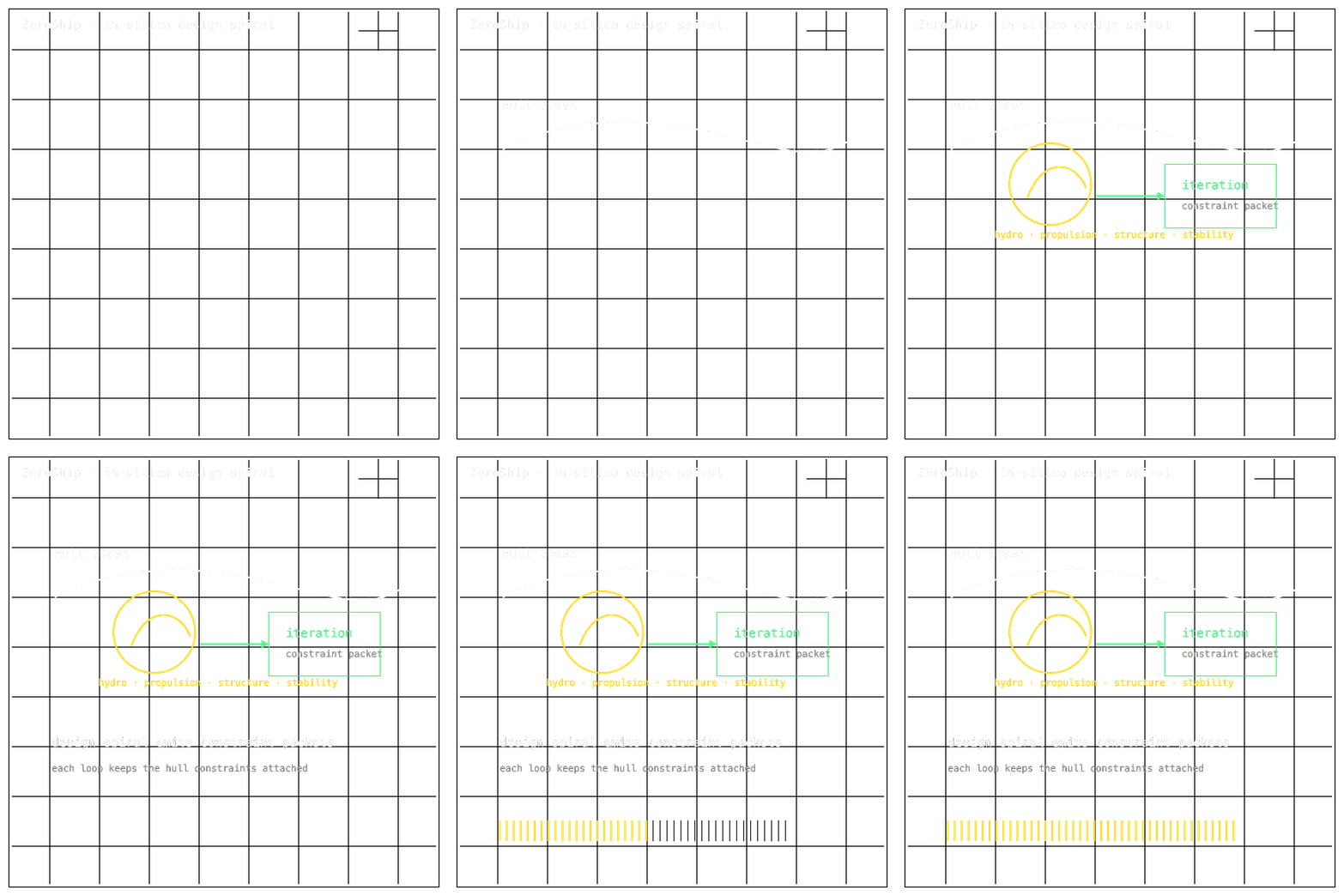
Global shipping carries roughly 80% of world trade and still burns the dirtiest fuel afloat. ZeroShip is the in-silico form of the MIT design spiral — hydrodynamics, propulsion, structure, arrangement, stability — running on one vessel concept until every discipline agrees on the same ship.
Hull 20098, a 10,955-tonne hydrogen-electric freighter at 14.36 MW installed power and 23 knots service speed, is the first public proving article. The page shows what the spiral converged on, and what it has not yet been asked to answer.
01 · THE GAPREADING IN SEQUENCE
Five disciplines have always read the hull; never simultaneously, never from the same vessel concept.
02 · MARKETSADJACENT FORECASTS
Adjacent transition forecasts. ZeroShip sits beneath them as the design workspace where every discipline reads the same hydrogen-electric ship.
03 · VALUE
$79.4B
Green shipping '31 forecast; an integrated five-discipline design workspace beneath it remains largely unpriced.
04 · INSIGHT
Iterate the spiral until the disagreements stop; that is the ship.
05.1 · CURRENT TECHREADING IN SEQUENCE
Ship design still runs each discipline in turn — hydrodynamics, then propulsion, then structure, then stability. By the time they all weigh in, the first assumptions are already stale and every team has answered a slightly different ship.
05.2 · OUR TECHONE LOOP, FIVE DISCIPLINES
ZeroShip runs all five through the same loop — hydrodynamics, propulsion, structure, arrangement, stability — each pass informing the next until the design converges on one ship. Hull 20098 sits in the loop today at 10,955 tonnes, 14.36 MW installed power, and 23 knots service speed; the page also names where the spiral has not yet been run.
05.3 · BENCHMARKSPLATFORM SURFACE
V_01READMEpublic packet
V_04packetboundary check
Dimensions15platform
Services6cross-cutting
On the page: what the platform is and where it stands — no private hull performance, no live-engine claim.
06 · MEASUREMENTV_01–V_04 SUITE
Four spiral passes name what holds and what does not.
06.1 · VERIFICATION RESULTS · V_01–V_04
Four passes covering the public-facing platform: what it is, where it stands, and what it deliberately holds back. Private performance models, classification certification, and a delivered hydrogen-electric hull are not yet on the page.
07 · KEY METRICSSPIRAL DIMENSIONS
07.1 · DIMENSIONS
15
naval-architecture domains · each one reads the same ship
07.2 · SERVICES
6
shared services every domain leans on · geometry, units, runs, evidence
07.3 · CASES
7
vessel concepts named in public · Hull 20098 is the first proven
07.4 · VERIFICATIONS
V_01–V_04
all four passes against the public page · what is in, what is held back
07.5 · ROLES
3
page, repo, evidence packet · live engine held private
08 · THE SPIRAL'S SCOPEWHAT THE SURFACE SHOWS
The spiral governs what is public and what is not.
08.1 · WHAT THE SPIRAL SHOWS PUBLICLYARCHITECTURE AND BOUNDARY
ZeroShip is the in-silico form of the MIT design spiral: five disciplines — hydrodynamics, propulsion, structure, arrangement, stability — cycling through the same vessel concept, each pass informing the next. The public page describes how the platform is organised, where Hull 20098 currently stands, and what the spiral is not yet claiming. Implementation source, detailed geometry, flow-analysis archives, OEM and partner data, and live engine operation stay private. A reviewer reads the shape of the spiral and a checked list of what is held back — not the working files behind it.
08.2 · THE FIDELITY GAP
Honest Blocker ·
No public implementation code, no package manifest, no PyPI project, no wheel, no command-line tool, no hosted service, no private geometry, no flow-analysis archives, no OEM data, no partner data, no vessel-status promotion, and no authorized restart of the live engine. Copy cannot close this boundary; named public evidence must.
09
FIVE DISCIPLINES, one ship.
09.1 · THE AMBITION
The aim is a shared design workspace where hydrodynamics, propulsion, structure, arrangement, and stability pass through one in-silico spiral until a hydrogen-electric vessel coheres. Hull 20098 is the proving article. What it lets a yard, a class society, or a financier do depends on the public evidence still being built.
09.2 · WHAT WORKS NOW
Working now: published platform architecture, current status, exclusion boundary, and four public-boundary checks passed.
09.3 · WHAT'S STILL OPEN
Still open: implementation source, hosted service, private geometry and flow archives, and authorized restart of the live engine.
09.4 · DESIGN REVIEW · NEAR-TERM (12–24 MO)
Concepts fail before the cheque clears
A naval architect can kill the wrong hull before procurement opens a hydrogen-vessel line item. When the discipline that would break the design breaks it in the spiral, the shipyard never quotes steel for a concept that could not survive its own physics.
09.5 · PROCUREMENT · NEAR-TERM (12–24 MO)
One ship for five disciplines to argue about
A maritime procurement lead stops chasing five separate consultant reports that read five different versions of the same vessel. Hydrodynamics, propulsion, structure, arrangement, and stability all answer from the same hull, so tradeoffs become one decision instead of five.
09.6 · CLASS AND COMPLIANCE · MID-TERM (24–48 MO)
Class society reads design and compliance together
A classification-society reviewer receives a vessel concept whose compliance evidence lives inside the design history, not stapled to it afterward. The first authority conversation about a hydrogen-electric freighter starts from a shared record of what was tested and what was excluded.
09.7 · TRANSITION ECONOMICS · MID-TERM (24–48 MO)
Hydrogen vessel claims arrive with cost receipts
A decarbonization-fund officer can ask whether a hydrogen-electric freighter pencils out and get an answer from the same loop that sized its propulsion. Capital allocators stop choosing between physics credibility and economic credibility — the spiral carries both.
09.8 · MARITIME R&D · PARADIGM (48 MO+)
A ship design becomes a regulated dossier
Early vessel R&D stops looking like marketing renderings and starts looking like a retained evidence object that regulators, insurers, financiers, and yards can interrogate years apart. The unit of trust in maritime transition shifts from the slide deck to the design dossier itself.