Measured product lead custody receipt.
github.com/Zer0pa/ZPE-IoTDEVELOPER-READY
LIVE
STALE PYPI
Telemetry That Keeps Its Shape
A codec that reads the shape of sensor streams · zpe-iot 0.1.1 · PyPI · github.com/Zer0pa/ZPE-IoT
Live experiment. Not a release. Ambition headlined. Claims bounded.
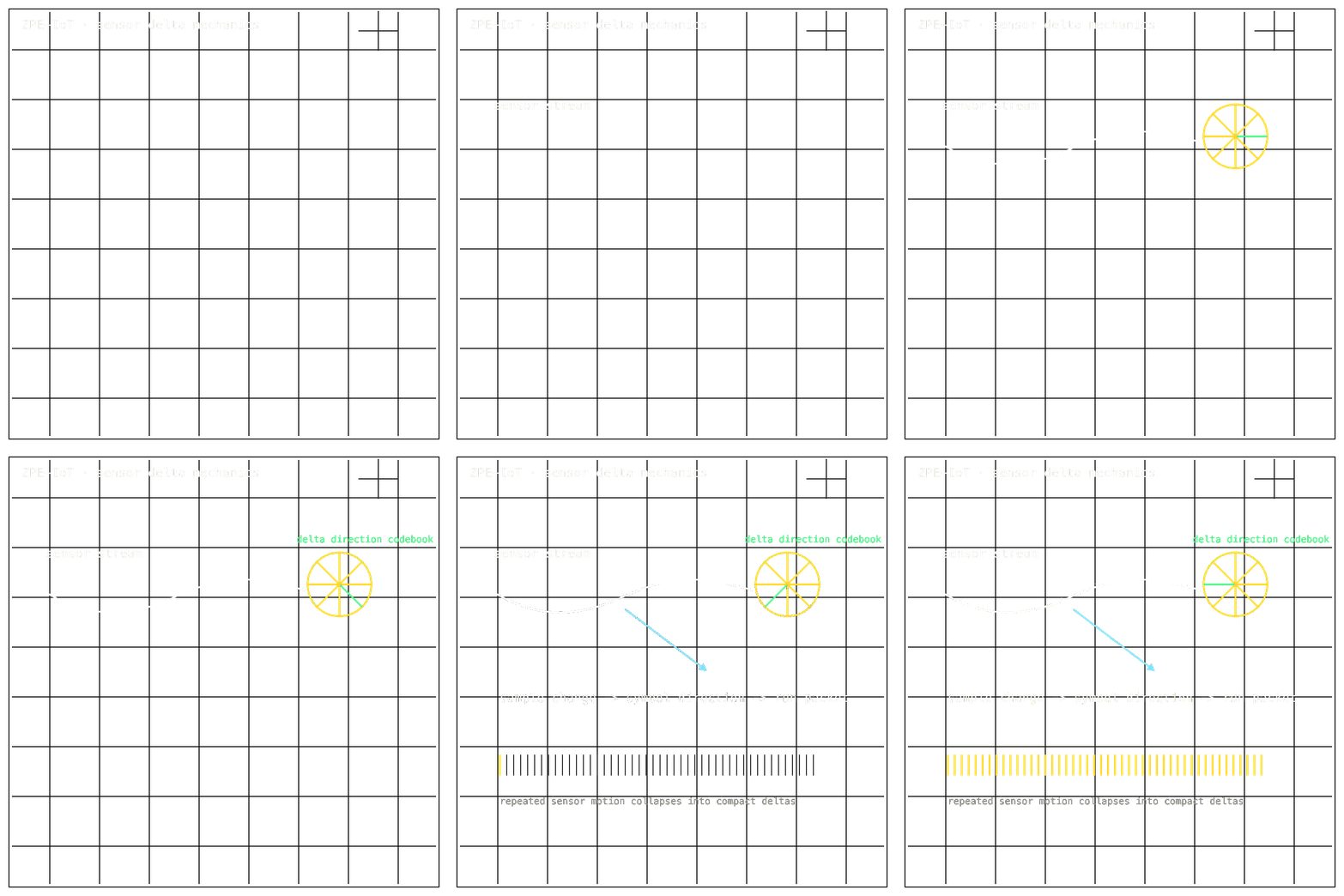
An accelerometer on a robot arm traces a smooth curve. A GPS tag follows a path. A pressure sensor rises and falls on a schedule. General compressors don't see any of that — they treat sensor data as bytes.
ZPE-IoT reads the shape underneath: 6.83× mean compression across ten real sensor datasets, ten wins out of ten against zstd's 2.87×. DS-12 stays on the page too — zstd 5957× to our 120× — disclosed and named.
01 · THE GAPBYTES, NOT SIGNALS
Sensor streams carry a shape. general-purpose codecs see only bytes — they don't read it.
02 · MARKETSADJACENT FORECASTS
Adjacent forecasts; ZPE-IoT is the encoding layer beneath sensor scale, not an IoT platform claim.
03 · VALUE
$426.2B
The 2030 sensor market; deterministic telemetry encoding is a quieter infrastructure layer beneath it.
04 · INSIGHT
Sensor data has a shape. a codec can read it.
05.1 · CURRENT TECHBYTES, NOT SIGNALS
Sensor telemetry moves through MQTT, Kafka, or SparkplugB and gets squeezed by zstd or gzip on the way. Lossless baselines see bytes — not the smooth curve of an accelerometer, the arc of a GPS path, or the rhythm of pressure.
05.2 · OUR TECHREAD THE SHAPE
ZPE-IoT reads the signal type — accelerometer, GPS, pressure, voltage — and encodes around its shape. The codec is bounded-lossy: it keeps what matters in a smooth trajectory and discards the rest. 6.83× mean compression across ten real sensor datasets. Ten wins out of ten against zstd's 2.87× baseline.
05.3 · BENCHMARKSREAL SENSOR DATA
E1 wins10 / 10DS-01..DS-10
Mean CR6.83×vs zstd 2.87×
Strict DT27 / 27tests, not bridge proof
DS-12disclosedcompetitor win
Bars: ZPE wins DS-04 and DS-07; DS-12 competitor win disclosed beside them.
06 · MEASUREMENTWIN SURFACE + DS-12
Ten datasets carry the wins. DS-12 sits beside them.
06.1 · COMPARATIVE PERFORMANCE · SENSOR TELEMETRY
Bounded-lossy ZPE-IoT against lossless baselines on accelerometer, GPS, pressure, and voltage telemetry — DS-01..DS-10. DS-12 competitor win disclosed alongside on an independent scale. DT-01..DT-27 determinism verified. Source: proofs/benchmark/.
07 · KEY METRICSMEASURED RESULTS
07.1 · E1 WINS
10 / 10
DS-01..DS-10 · ten real sensor datasets
07.2 · MEAN CR
6.83×
vs zstd 2.87× · DS-01..DS-10 mean
07.3 · STRICT DT
27 / 27
DT-01..DT-27 · 27 strict tests pass
07.4 · DS-12 BOUNDARY
disclosed
zstd 5957× · ZPE 120× · competitor win
07.5 · RELEASE
v0.1.1
PyPI 0.1.1 · stale pending release
08 · DETERMINISMWHAT THE CODEC COMMITS
The codec commits what it can read. DS-12 proves the limit.
08.1 · WHAT DETERMINISTIC MEANSCODEC SURFACE ONLY
ZPE-IoT commits deterministic encode/decode tests for the codec surface — not broker transport or downstream IoT-stack behaviour. DT-03 verifies 10,000-seed determinism, DT-11 verifies cross-platform parity, and DT-09 holds 0.031 ms native encode latency.
DS-12 is a different question. On that dataset a competitor codec reads the shape better: zstd reaches 5957× and ZPE-IoT reaches 120×. The win surface stays DS-01..DS-10, with DS-12 disclosed outside it on every page that reports the numbers.
08.2 · HONEST BLOCKER
Honest Blocker ·
DS-12 is a transparent competitor win — zstd 5957.82× against ZPE-IoT 120.47×. DS-11 is blocked. PyPI 0.1.1 sits stale pending the next release. No production MQTT, Kafka, or SparkplugB bridge is claimed yet — only the codec itself ships.
09
WHEN TELEMETRY keeps its shape.
09.1 · THE AMBITION
The ambition is sensor transport that understands what it carries. An engineer running a fleet of accelerometers, GPS tags, and pressure cells should get encoding that reads the stream rather than guessing at the bytes. DS-11, a production broker bridge, and a clean release stand between today and that fleet.
09.2 · WHAT WORKS NOW
Working today: 6.83× mean compression across ten real sensor datasets, with 27 of 27 determinism tests passing.
09.3 · WHAT'S STILL OPEN
Still open: DS-11 blocked, PyPI 0.1.1 stale, DS-12 competitor gap named; no production broker bridge exists yet.
09.4 · SENSOR HISTORY · NEAR-TERM (12–24 MO)
Factories keep the whole stream
A plant manager who used to downsample vibration and pressure traces for storage can now retain the full record. When a bearing fails, the engineer asking what this machine sounded like a month ago gets an actual answer, not a coarse summary.
09.5 · FLEET ECONOMICS · NEAR-TERM (12–24 MO)
Bandwidth bills shrink with the fleet
A connected-device team running thousands of cellular sensors pays for every byte over the radio. Reading the shape instead of the bytes turns a 2.87× compression budget into a 6.83× one, so the line item that funds the next product hardware refresh actually moves.
09.6 · CODEC ROUTING · MID-TERM (24–48 MO)
Telemetry platforms pick by signal
An IoT platform team can route smooth-trajectory streams through this codec and keep zstd for the regular byte patterns it handles best. DS-12 stays named in the routing table, so the choice is transparent to anyone procuring the platform.
09.7 · INDUSTRIAL ARCHIVE · MID-TERM (24–48 MO)
Telemetry archives become searchable
A reliability engineer comparing this year's compressor cycles to last year's stops grepping log files and starts asking the archive about shape directly. Pressure rises, route arcs, voltage steps and vibration drift turn into records other engineers can find.
09.8 · SHAPE-NATIVE EDGE · PARADIGM (48 MO+)
The edge speaks in signals
When devices ship signal shape rather than anonymous bytes, the connected-product industry stops treating telemetry as raw exhaust. Engineers, regulators, and customers can ask which device produced which behaviour and get a deterministic answer back, not a guess pulled from logs.