Measured product lead custody receipt.
github.com/Zer0pa/ZPE-ImageRESEARCH-READY
LIVE
EXTERNAL COMPARATORS OPEN
Store the shape, not the screenshot.
Sparse-stroke encoder · ZPE-Image · zpe-image 0.1.0 stale · github.com/Zer0pa/ZPE-Image
Live experiment. Not a release. Ambition headlined. Claims bounded.
Most image codecs sell one number: bytes saved on photographs. ZPE-Image sells two. On five sparse structural figures — glyphs, mazes, flow-graphs, skeletons — it delivers 5.75× byte reduction against the internal baseline.
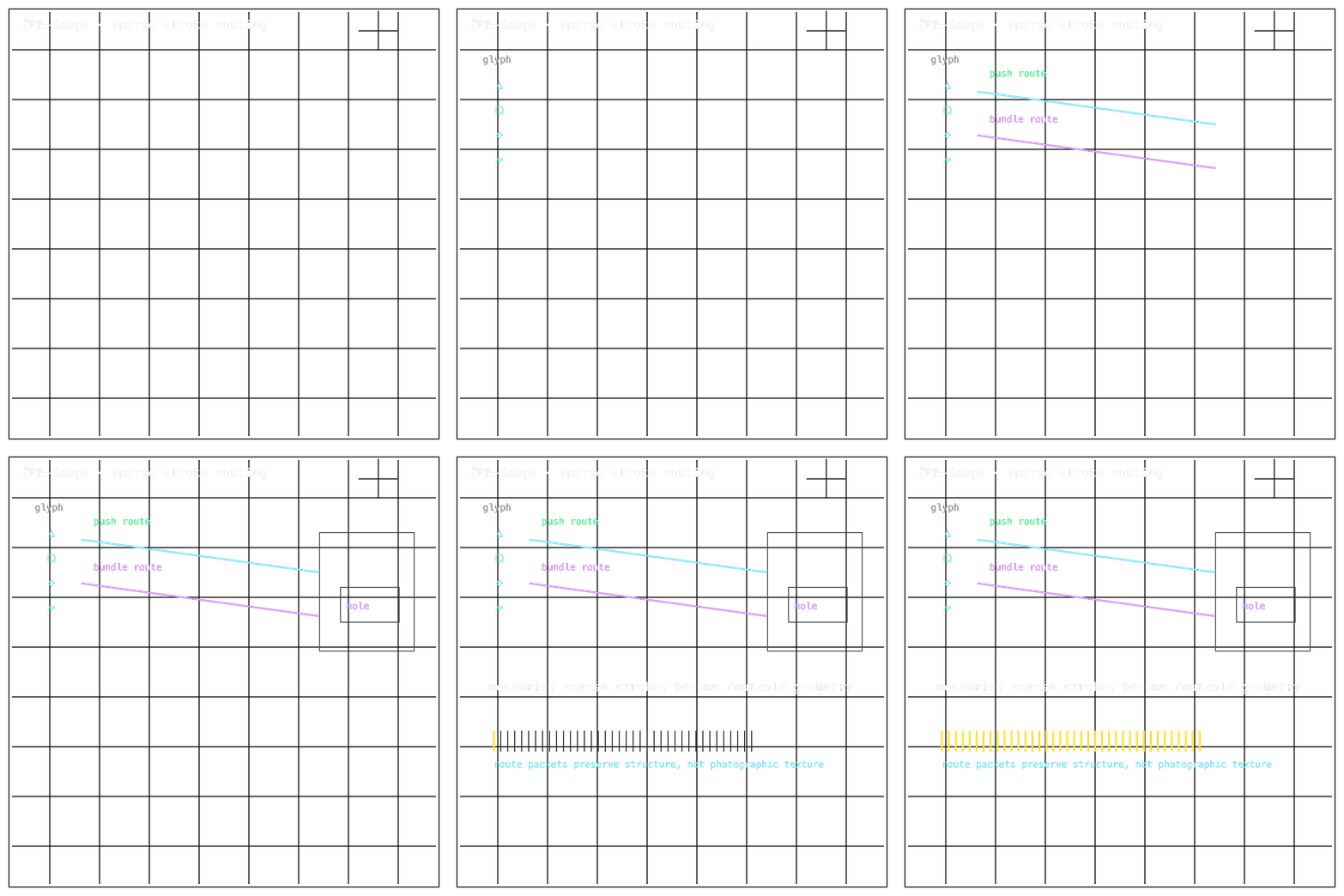
On seven natural and mixed inputs, it returns a refusal at encode time. The codec is built to answer two questions in one packet: what it stores, and what it will never accept. Photographs are not in scope, and that is the point.
01 · THE GAPENCODED OR REFUSED
No compact codec addresses sparse structural strokes while explicitly refusing everything else.
02 · MARKETSADJACENT FORECASTS
Every technical drawing held in a corporate archive touches these markets; ZPE-Image addresses the sparse-stroke slice that compresses without taking in photographs.
03 · VALUE
$1.9B
2030 diagramming software; ZPE-Image is the sparse-stroke archive slice inside that category.
04 · INSIGHT
Structural drawings need a bounded archive.
05.1 · CURRENT TECHCOMPRESS EVERYTHING
JPEG, WebP, AVIF, and JPEG-XL compress photographs. SVG describes vectors. None of them ask whether the input is the right kind of image. A maze, a glyph, a skeleton sits inside formats built for something else.
05.2 · OUR TECHKNOW THE BOUNDARY
ZPE-Image encodes structural figures where the line itself carries meaning. It names its accepted scope — 5 of 5 sparse figures — and its categorical refusals — 7 of 7 natural and mixed inputs — inside the same packet. On accepted figures, bytes drop by 5.75× against the internal baseline. On the rest, the codec returns nothing.
05.3 · BENCHMARKSACCEPT / REJECT PACK
Bytes5.75× vs quadtree
Accept5/5sparse figures
Reject7/7natural negatives
Floors0.632IoU · F1 0.741
Scope: internal baseline only. JPEG, WebP, AVIF, and JPEG-XL comparator runs are open.
06 · MEASUREMENTACCEPT/REJECT PACKET
Every measurement names the codec boundary — accepted and refused inputs.
06.1 · COMPARATIVE PERFORMANCEINTERNAL BASELINE BYTES
Five sparse figures accepted, seven natural and mixed inputs refused. Perturbation floors: IoU 0.632, skeleton F1 0.741 under four perturbation types. Artifact dated 2026-04-21. External comparators against JPEG, WebP, AVIF, JPEG-XL not yet closed.
07 · KEY METRICSMEASURED RESULTS
07.1 · INTERNAL BYTES
5.75×
vs internal baseline · five accepted sparse figures
07.2 · ACCEPTED
5/5
sparse figures accepted · internal sparse pack
07.3 · REJECTED
7/7
natural and mixed inputs refused · at encode time
07.4 · PERTURBATION FLOOR
0.632
IoU 0.632 · skeleton F1 0.741 · four perturbation types
07.5 · PROOF PACKET
04-21
2026-04-21 · PyPI zpe-image 0.1.0 stale
08 · SCOPE ENFORCEMENTACCEPTED STRUCTURE ONLY
The archive stays useful because the boundary is enforced.
08.1 · WHAT THE BOUNDARY MEANSACCEPT / REJECT
On five accepted sparse figures, the dated artifact reports 5.75× byte reduction against the internal quadtree fallback. Seven natural or mixed inputs are refused at encode time, so photographs and wrong inputs never enter the structural archive in the first place. Under four perturbation types — dilate, salt-and-pepper, x-shift, y-shift — the accepted figures hold an IoU floor of 0.632 and a skeleton F1 floor of 0.741. The structural identity of a stored drawing survives a degraded source.
08.2 · HONEST BLOCKER
Honest Blocker ·
Natural-image coverage is out of scope by design, not a gap. External comparator closure against JPEG, WebP, AVIF, JPEG-XL, gzip, SVG, and PNG is open. The five-figure corpus has not been expanded. PyPI zpe-image 0.1.0 is stale, with a corrected release pending.
09
A CODEC THAT knows what it refuses.
09.1 · THE AMBITIONA BOUNDARY THAT HOLDS
The aim is a structural archive for the world's technical drawings — engineering diagrams, glyphs, schematic flows, hand-drawn proofs — that compresses where line structure carries the meaning, supports retrieval by shape, and physically refuses to swallow photographs that would corrupt the corpus and the compression claim along with it.
09.2 · WHAT WORKS NOW
Working today: 5.75× byte reduction on five accepted sparse figures, 7 of 7 photograph refusals, perturbation floors held.
09.3 · WHAT'S STILL OPEN
Open: external comparator closure against JPEG, WebP, AVIF and JPEG-XL; a current PyPI release; corpus expansion.
09.4 · ARCHIVES · NEAR-TERM (12–24 MO)
Engineering archives hold more drawings
A technical-illustration archive on a fixed storage budget can keep roughly six times more sparse figures online. The procurement question stops being “what do we delete this quarter” and becomes “what else can we keep accessible.”
09.5 · PROCUREMENT · NEAR-TERM (12–24 MO)
Buyers can pick a codec that refuses
A procurement team choosing a structural archive codec can specify behavior on out-of-scope inputs. A codec that rejects a photograph at encode time is a different purchase than one that silently produces garbage, and the contract can say so.
09.6 · STANDARDS · MID-TERM (24–48 MO)
Drawing standards gain a refusal contract
Engineering-drawing and digital-humanities standards bodies can adopt scope-refusal as a spec property, not a warning in documentation. The format itself enforces what it does not encode, so downstream pipelines stop inheriting silent degradation as a category of bug.
09.7 · SEARCH · MID-TERM (24–48 MO)
Drawing archives become searchable by shape
When the same structural figure encodes to the same compact packet, searching a glyph or schematic archive by skeleton topology stops being a brute pixel-similarity problem. Researchers and engineers find drawings the way they think about them — by structure.
09.8 · IDENTITY · PARADIGM (48 MO+)
A drawing has a name, not just a file
Once a structural figure resolves to the same packet across draftspeople and tools, a drawing acquires an identity independent of its file. Citation, provenance, and version chains for technical drawings become first-class, the way they already are for text and code.